
Assembling Disneyland’s Trajectories Mapping the Real and the Imaginary
Figure 1: Diagram of the analytical framework on how to interact with L’Agencement Disneyland. Heterogeneous elements and forces constitute the assemblage in which its diagrammatic functioning is made legible through three trajectories: “territorialization” (Planned, tracing operation), de-/reterritorialization (Emergent Trajectory, mapping operation), and creative transformation via lines of flight (Expansive Trajectory, producingoperation). The Expansive Trajectory escapes the assemblage as a mutation in order to produce America and later again, Disneyland.
THEORY: L’AGENCEMENT DISNEYLAND
Disneyland is Real and Imaginary
In critical accounts Disneyland (1955), Anaheim, California, is often depicted as both mundane and unadorned, while also being celebrated as a representation of American culture. This duality is complicated by the fact that Disneyland is intricately embedded within, and part of, the real-world, while simultaneously constitutes an autonomous, imaginary world, as a produced territory—an artificial world in itself.
Beyond this (im)material embeddedness, Disney’s design of leisure spaces, the representation of historic architecture, and urban narratives has profoundly shaped the real-world shopping centres, resorts, and townscape expectations (Olsberg, 1997, p. 9).
Disneyland, then, is not the real America, but represents an ideal America, which could therefore be seen as a hyperreality: a condition in which it is more real or significant than reality itself. (Venturi, Scott Brown and Izenour, 1972)
However, Baudrillard does not describe Disneyland itself as a hyperreality, rather he considers its surrounding America as hyperreal,
Disneyland is presented as imaginary in order to make us believe that the rest is real, whereas all of Los Angeles and the America that surrounds it are no longer real, but belong to the hyperreal order and to the order of simulation (Baudrillard, 1994, p. 12).
America itself is a simulation, that conceals—by presenting Disneyland as an imaginary world—the absence of the real it pretends to represent: “Disneyland exists in order to hide that is the ‘real’ country” (Baudrillard, 1994, p. 12).
If we now consider that Disneyland can be read as simultaneously real, ideal, and imaginary America, the question arises of what, if anything, could still function as an original America. Is Disneyland merely a copy of America, or does America increasingly appear as a copy of Disneyland? Or does this reciprocal mirroring undo the very logic of copy and original altogether? In such a configuration, Disneyland may not be a copy, but a simulacrum that produces the reality it seems to represent.
Following Deleuze’s overturning of Platonism, the logic of the copy and original is itself undone. For Plato, according to Smith, the copy is “good” when it participates in the Idea, while the simulacrum is bad, “a deceptive resemblance without foundation” (Smith, 2012, p. 14). Deleuze reclaims the simulacrum as something altogether different: not a degraded copy but a productive difference that generates its own reality. According to Smith, the simulacrum “has internalized the differential nature of the Idea” (Smith, 2012, p. 14) and therefore becomes a site of creation rather than a copy, producing reality rather than reflecting it.
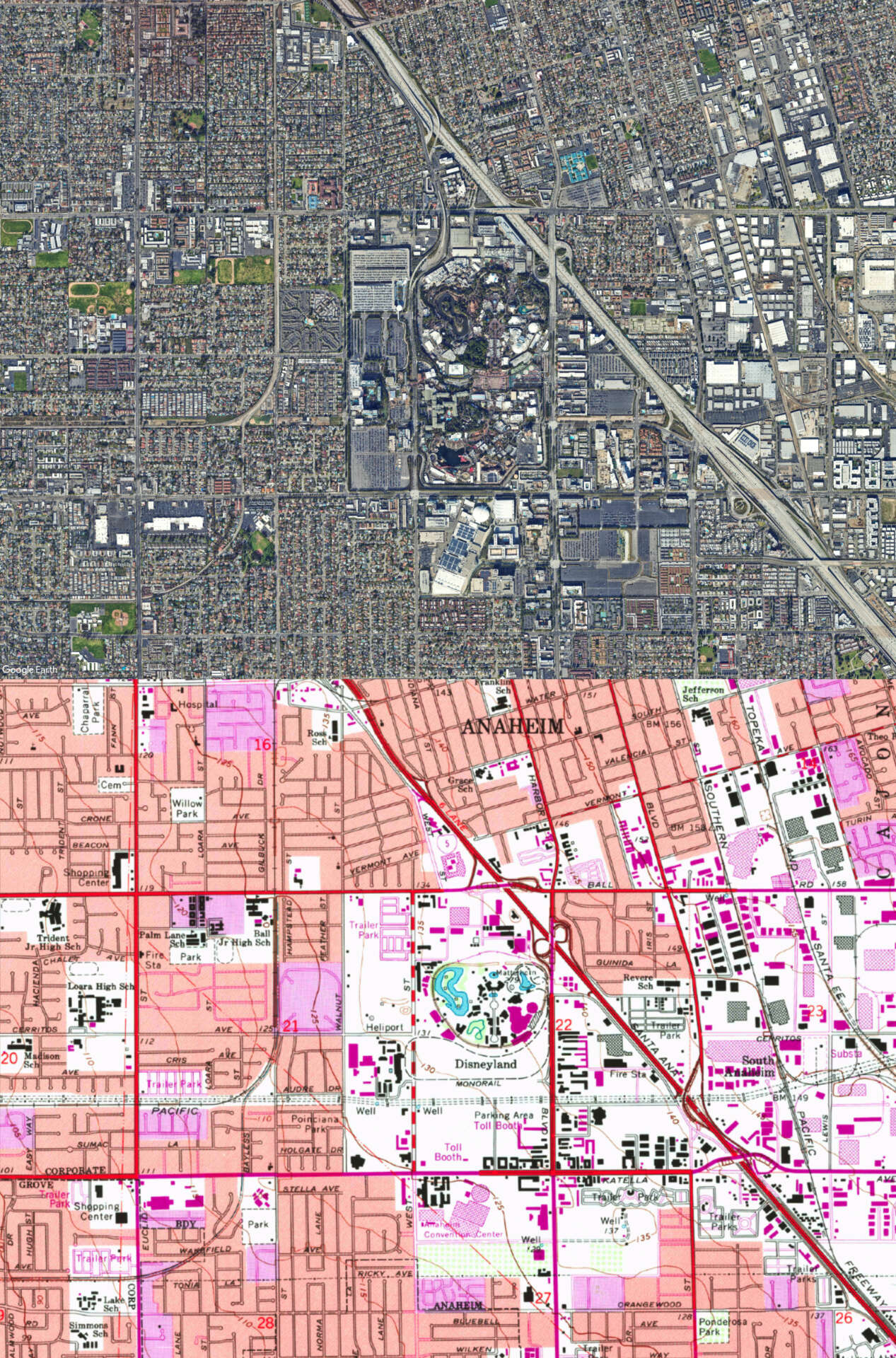
Figure 2: Anaheim, California, satellite imagery (top) and topographic map of 1965 (bottom). Disneyland is intrinsically embedded in the urban fabric of Anaheim. The topographic map reveals this with particular clarity: the magenta planned interventions extend across the park boundary without distinction.
Imagery ©2024 Airbus, Data CSUMB SFML, CA OPC, Landsat / Copernicus, Maxar Technologies, Map data ©2024 Google (U.S. Geological Survey, 1965; Google, 2024).
Disneyland is, opposed to Baudrillard, then, not a mask covering reality, but an abstract machine (Deleuze and Guattari, 1987, p. 141) for producing new ones—territories of affect and nostalgia that are every bit as material as its urban surroundings. It is real because it produces; imaginary because it produces the difference. In this way, Disneyland functions less as a false representation and more as a field of simulacra whose relations of production can be approached as a functioning assemblage: (Parr, 2010, p. 18) Disneyland ís America and America ís Disneyland, continuously producing each other.
Disneyland as a Functioning Assemblage
Considering Disneyland as a functioning assemblage, L’Agencement Disneyland,1 enables Disneyland to emerge from the arrangement of heterogeneous elements into a—albeit temporarily—diagrammable productive entity. Disneyland’s diagram is therefore the map of its functioning (a “map of destiny”); it is “the code or arrangement by which an assemblage operates.” To map a diagram, we must identify not only the heterogeneous elements that compose it, but also a set of forces that arrange these elements into productive relations (Parr, 2010, p. 18).
Some Heterogeneous elements that constitute Disneyland as a functioning assemblage could, among others, include:
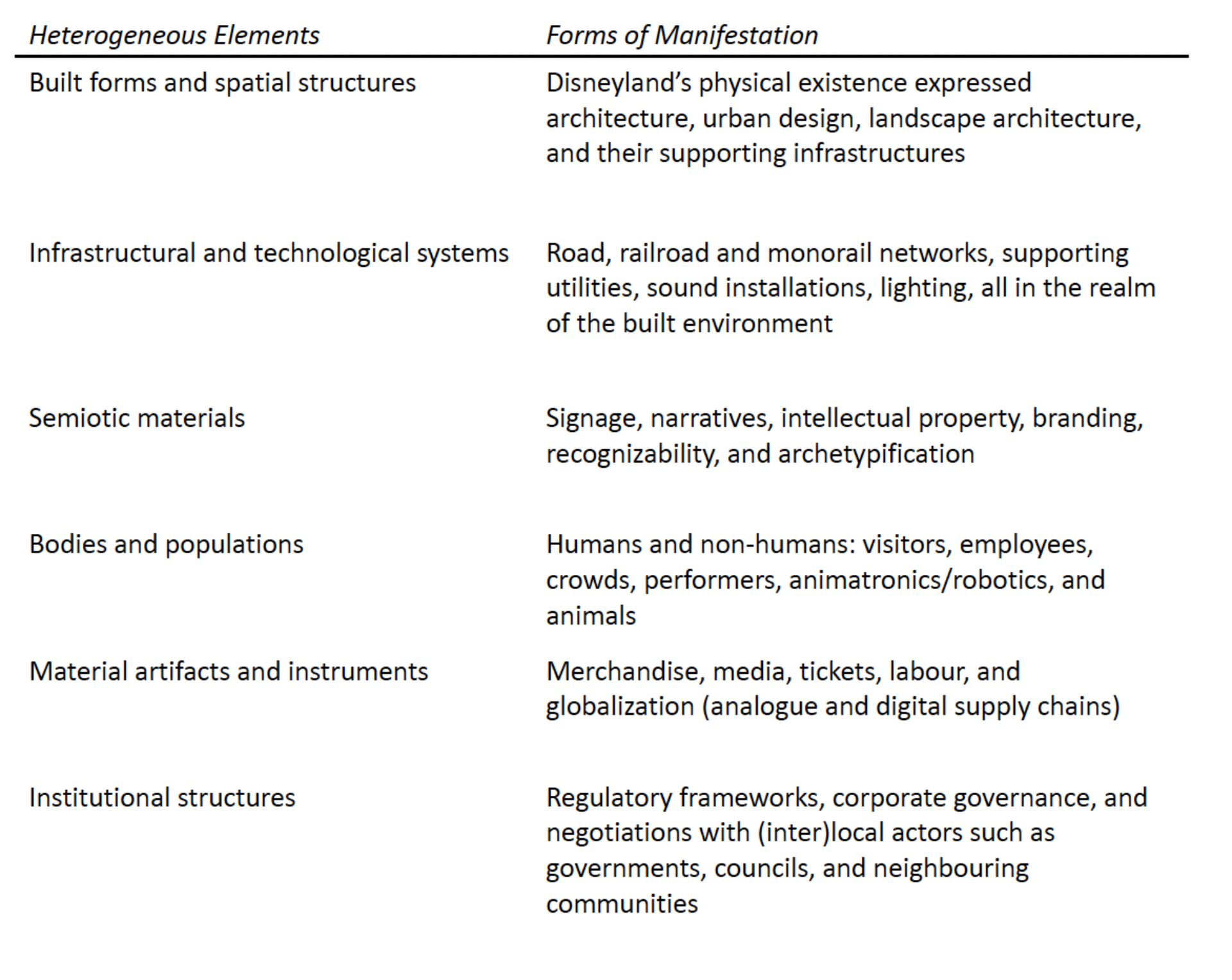
Table 1: Possible heterogeneous elements and their forms of manifestation through which Disneyland materially and immaterially substantiates as an assemblage.
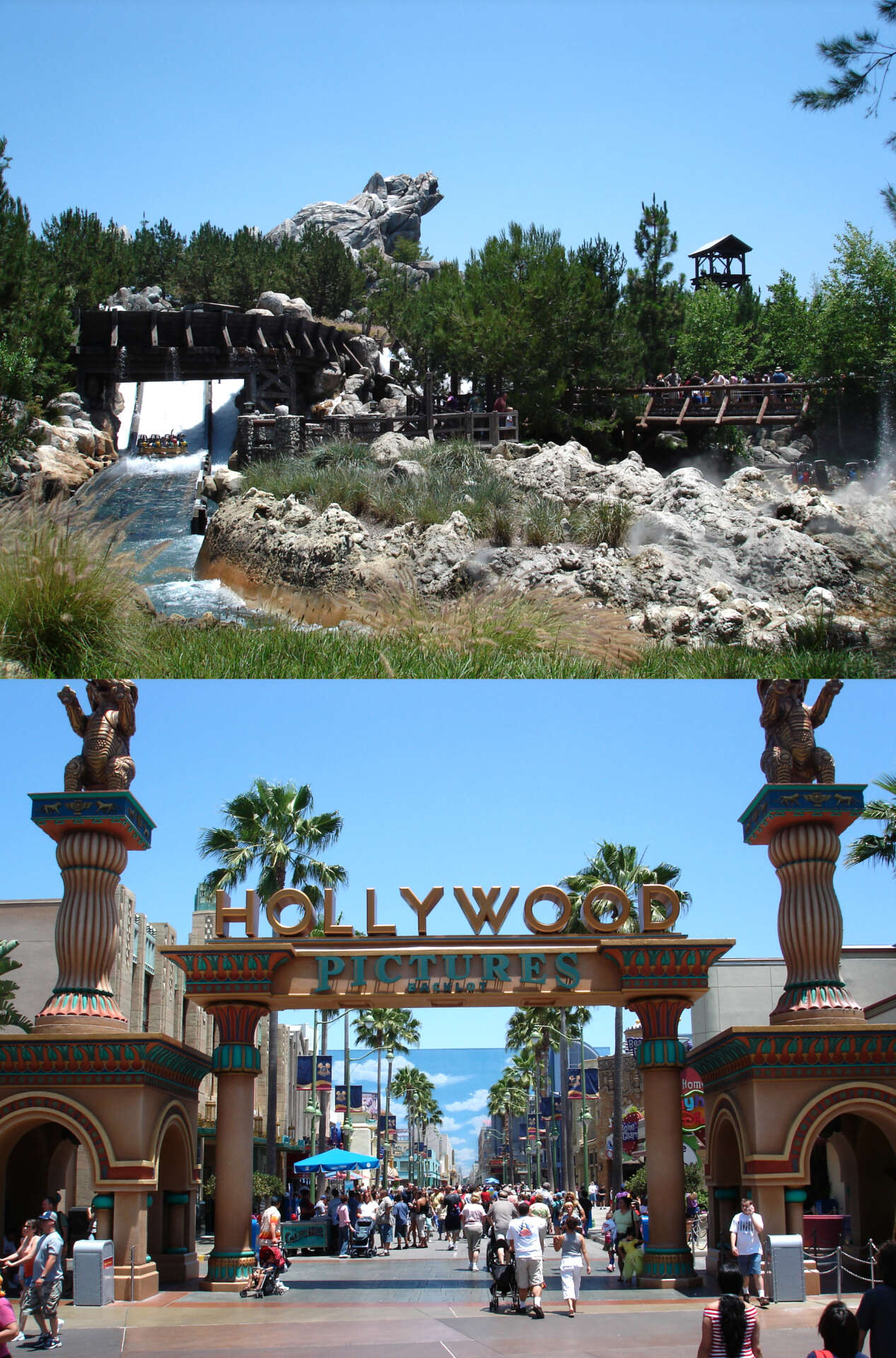
Figure 3: Themed lands Grizzly Peak Airfield (top) and Hollywood Land (bottom) in Disney California Adventure, Disneyland Resort, Anaheim, California. Not only is Disneyland located in America—America is also located in Disneyland, as an idealized projection of itself. This makes Disneyland a hyperreality: a condition in which the simulation becomes more real, or more significant, than the reality it represents. The proximity of the real Hollywood—30 miles away, an hour’s drive—only sharpens the point. Photographs by Joran Kuijper, June 2006.
A set of forces that circulate through and arrange these elements in Disneyland could be, among others:
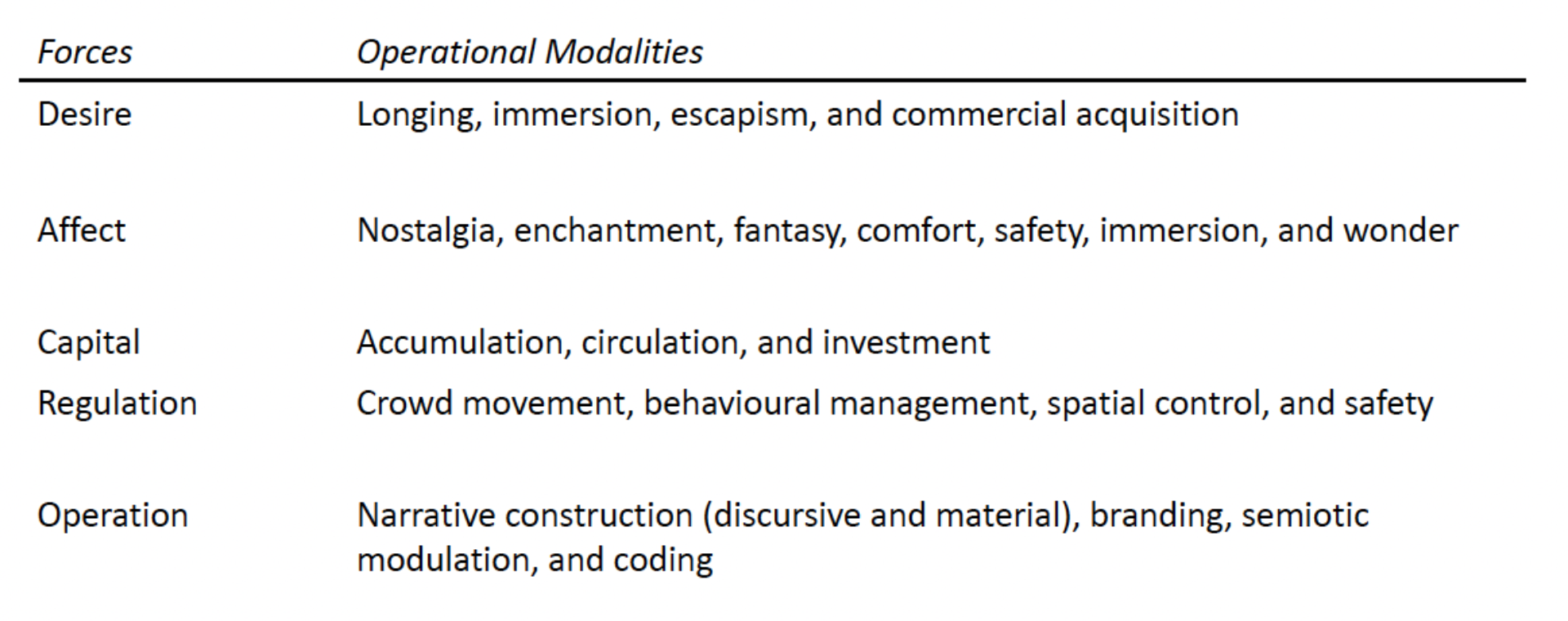
Table 2: A possible set of forces and their operational modalities through which Disneyland’s assemblage operates and exerts effects.
Through the interrelation of heterogenous elements and a set of forces, Disneyland directly produces a territorializedworld: a space in which bodies, affects, meanings and the like are operationalized and regulated. The assemblage, for example, captures desire and channels it into consumable spatial narratives for visitors and employees. As a result, L’Agencement Disneyland produces new realities, affects, and therefore indirectly de- and reterritorializes, and ultimately facilitates creative transformation.
From Lines to Trajectories
Creative transformation becomes intelligible when we consider, following Deleuze and Guattari, that assemblages contain three simultaneously operating lines, providing its productive topology: the “molar line,” the “molecular line,” and the “line of flight that ruptures the other two lines” (Parr, 2010, p. 147).
It is by the line of flight that assemblages may be transformed, because the line of flight “systematically privileges processes of creative transformation and metamorphosis” (Parr, 2010, p. 118). Transposed to Disneyland, we can conceptualize three different trajectories: the Planned Trajectory, the Emergent Trajectory, and the Expansive Trajectoryto prove that the L’Agencement Disneyland contains the power to reterritorialize:
1. The molar line [territorialization, the real-world] describes Disneyland as a static, physically confined, designed and crafted urban architectural environment with carefully designed paths, queues, and attractions: a coded order. This line also prescribes how visitors consume fantasy (which in itself is real-built and economically embedded, tangible and assessable) and (should) experience happiness.2 We can consider this line as a Planned Trajectory.
2. The molecular line [deterritorialization that permits reterritorialization, the imaginary ánd artificial (as is everything produced by human) world] is embodied by Disneyland’s human and non-human occupants:3 visitors, employees, and animals, all with their individual and collective itineraries, emotional responses, and unexpected deviations. Disneyland needs this spontaneous appearance to maintain a territorialized stability. The visitors mediate between participating and destabilizing this system. We can consider this line as an Emergent Trajectory.
3. The line of flight [“creative metamorphoses” (Parr, 2010, p. 147), the successive real-world, after Disneyland] is the rupture, the escape,4 or the transformation that will exceeds Disneyland’s coded and decoded boundaries. It is the moment and how the visitors and employees take experiences, as life-changing memories by producing their affect by being the embodiment of a molecular line. Or how the Disney model leaks into urban reality—influencing malls and. We can consider this line as an Expansive Trajectory.5
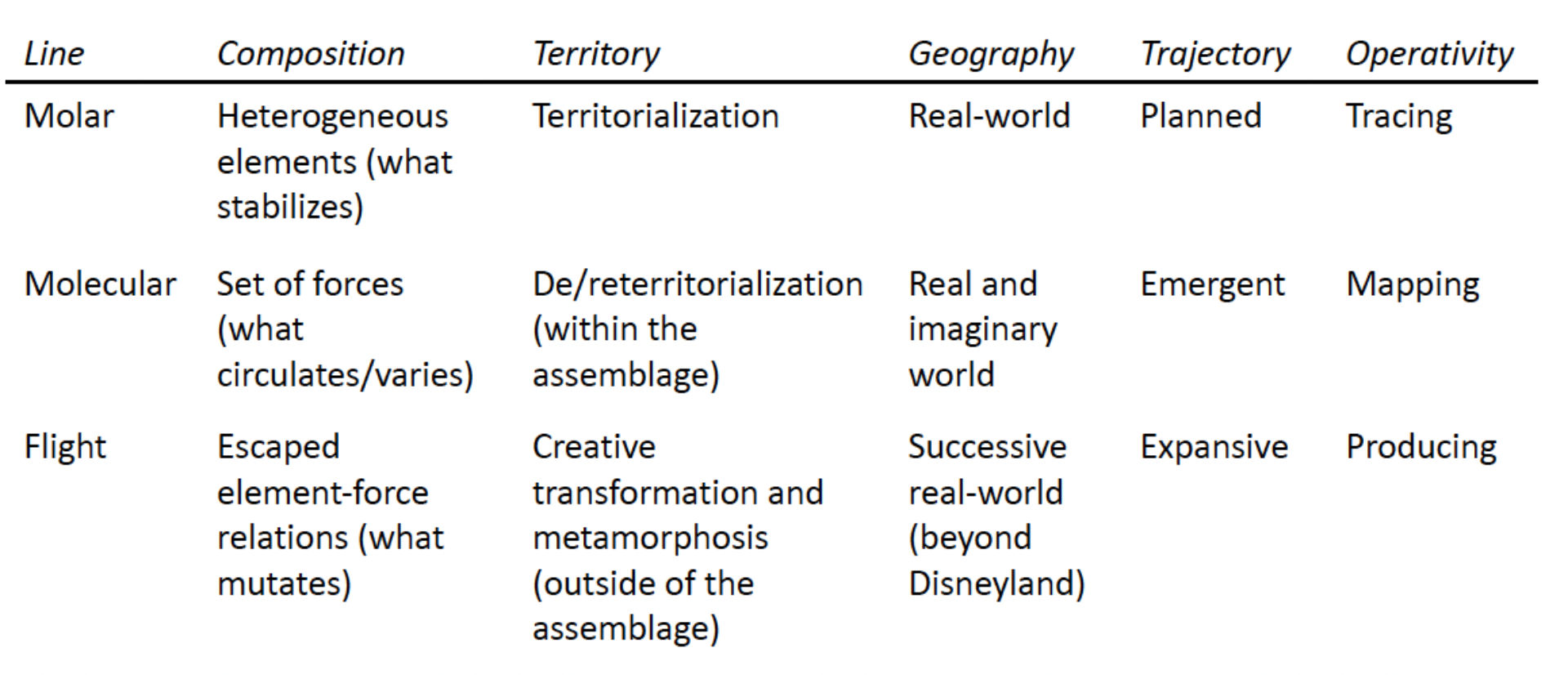
Table 3: Correspondence between the six attributes—Line, Composition, Territory, Geography, Trajectory, Operativity—and their parameters, through which Disneyland functions as an assemblage.
The columns of the table above function as attributes—Line, Composition, Territory, Geography, Trajectory, Operativity—each taking specific parameters per line. Their configuration at any given moment constitutes a diagrammatic snapshot of the assemblage, through which operative mapping becomes possible.
The relationship between heterogeneous elements, forces, and the three lines is not arbitrary. The molar line corresponds to the material stability of heterogeneous elements—what is built, regulated, and fixed. The molecular line corresponds to the circulatory dynamics of forces—what flows through, animates, and varies those elements. The line of flight emerges when element-force relations escape the assemblage and mutate into new configurations elsewhere, producing successive territories beyond Disneyland’s physical boundaries.
Because of their rhizomatic behaviour, lines of flight are productive and mappable. They indicate that even within controlled environments, imagination and desire escape their respective codification. This essay considers the line of flight as an analytical lens: a way to study Disneyland (and therefore America) as it simultaneously produces and is undone by its own logics of immersion and control.
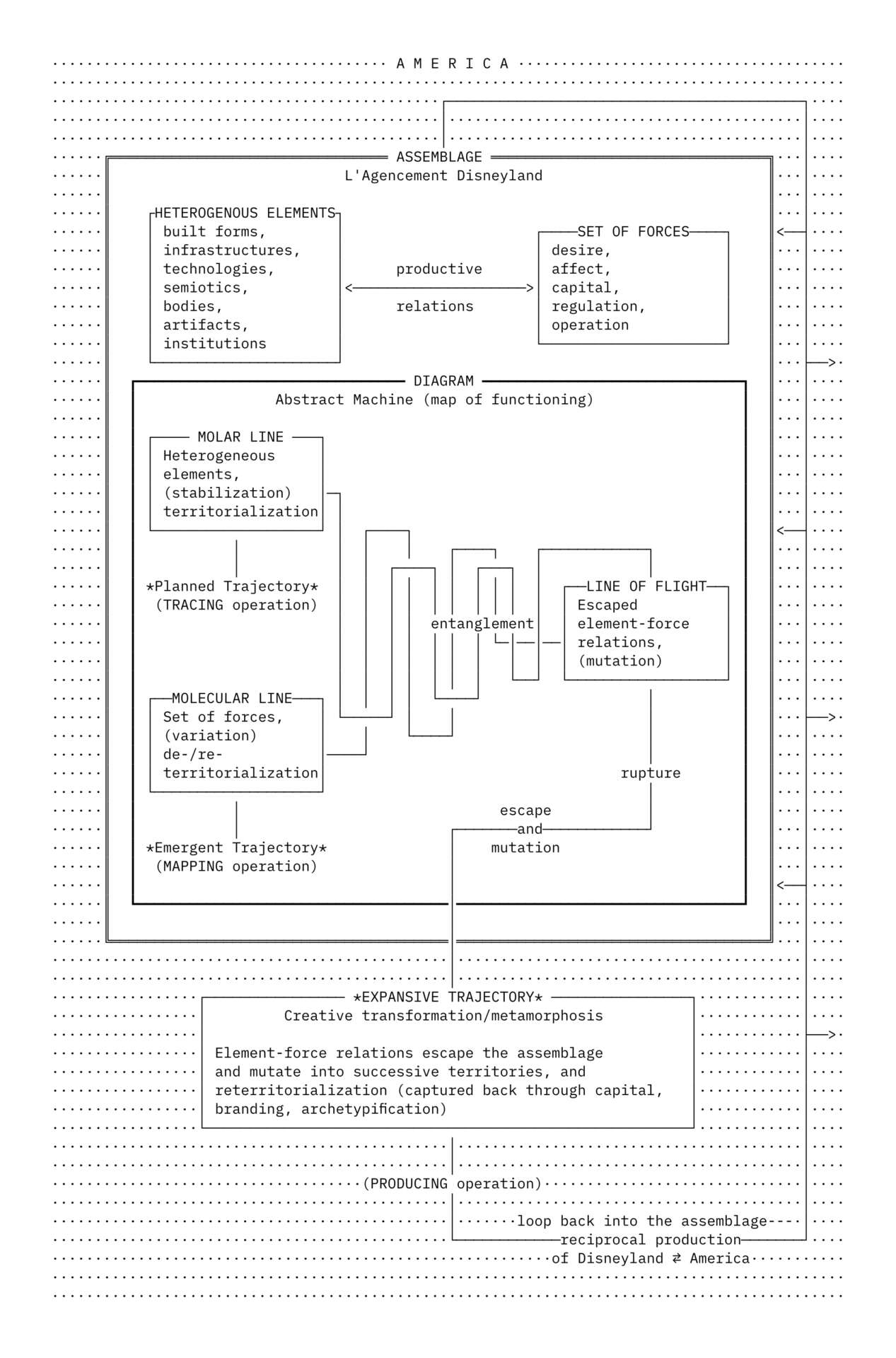
Figure 4: Visualization of heterogeneous elements and set of forces apparent in Disneyland. In order to make a diagram of this, one or more heterogeneous elements and a subset of forces need to be isolated and their trajectories can be operatively mapped in order to get an insight of Disneyland as a functioning assemblage. Figure by Joran Kuijper, 2026.
METHODOLOGY: FROM SIMULACRUM TO OPERATIVE PRACTICE
Mapping Assemblages
Because L’Agencement Disneyland is by nature not representational,6 a shift from a representational tracing practice toward an operative mapping practice is required. This shift is necessary in order to engage with Disneyland’s diagram, understood not as a form to be depicted but as an arrangement of elements and forces that organize the functioning of the assemblage.7 Mapping is therefore not employed to reproduce or depict this diagram, but as an operative activity that constructs trajectories through which the diagram’s functioning can be engaged. Henceforth, by making three trajectory-based mappings, spatial knowledge can be obtained about how Disneyland produces, territorializes, destabilizes, and transforms space within and beyond its boundaries.
Following Paez, (Paez, 2019, pp. 23–28) mapping is understood here as an open and performative system oriented toward experimentation,8 while the diagram refers to the abstract machine or functioning that organizes relations within an assemblage (Deleuze and Guattari, 1987, p. 141). Drawing on critical cartography, (Harley, 1989; Wood, 1992; Crampton and Krygier, 2006) the mappings that will be developed through this essay operate as critical and operative constructions that articulate Disneyland’s diagrammatic functioning.
In line with the assertion of Corner (1999) that maps are not passive mirrors of reality but active agents in their construction, mapping is deployed here as a performative, design-driven research practice. Maps do not simply passively record spatial conditions; they intervene, speculate, and produce new relations (Corner, 1999). As Paez argues this toward operative maps, they “expand the field of the real and promote its transformation” (Paez, 2019, p. 19).
Disneyland’s trajectories can be mapped because they are rhizomatic rather than arborescent in nature. Arborescent structures produce rooted (pun not intended), hierarchical paths that can only be traced, whereas rhizomatic structures generate dynamic and non-hierarchical trajectories that emerge through mapping (Deleuze and Guattari, 1987, pp. 12–13). Diagrammatic clarity emerges through the feedback between mapping and tracing, where provisional stabilizations are continually disrupted by further mapping. The diagram thus presents forces rather than forms—not depicting what Disneyland looks like but revealing how it operates (Deleuze and Guattari, 1987, p. 141).
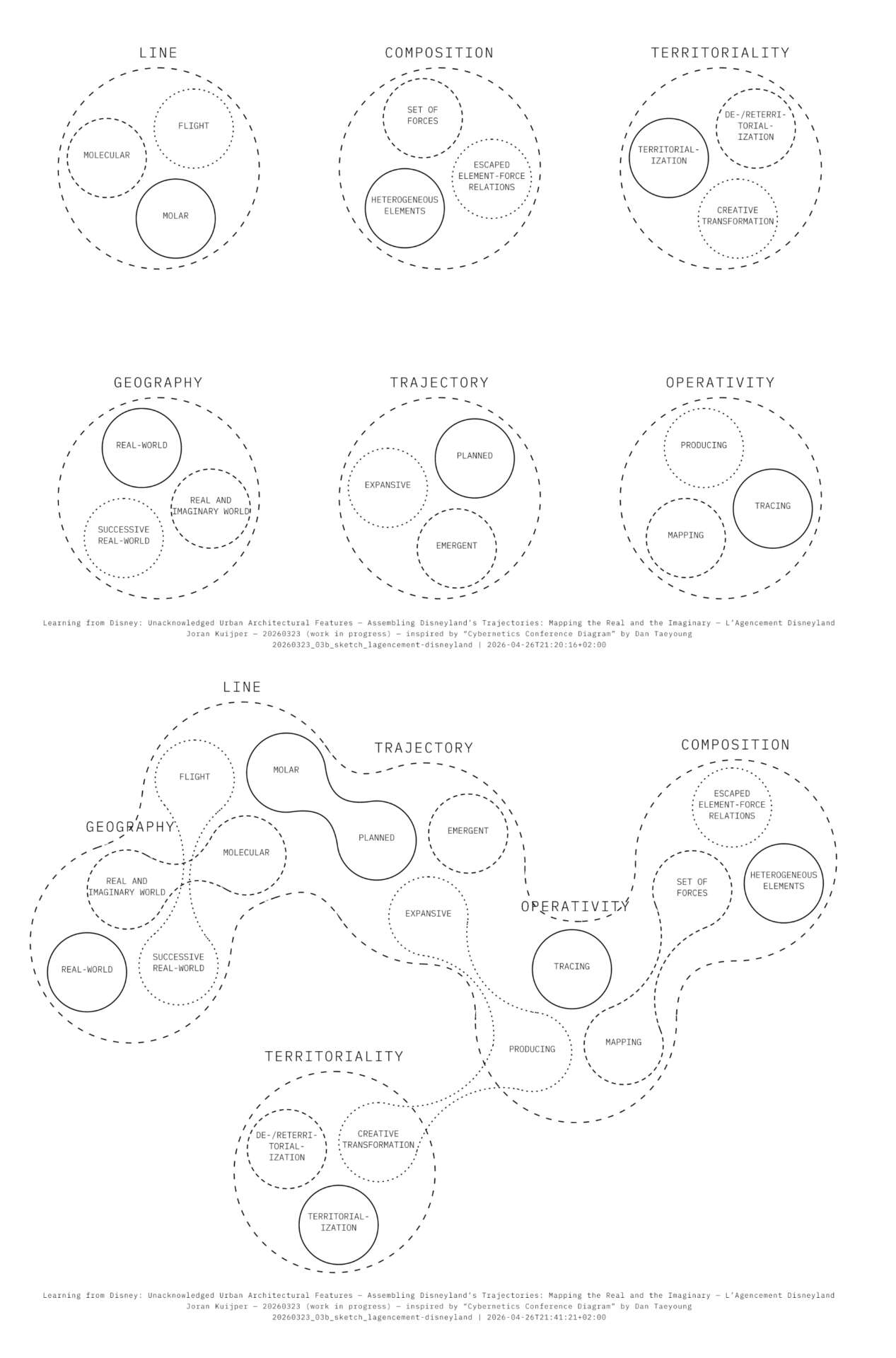
Figure 5: The position of the assemblage within a larger constellation of assemblages (top). The assemblage fed by molar lines and releasing molecular lines, one of which is the Line of Flight informing a new assemblage (bottom). Sketches by Joran Kuijper, 2026.
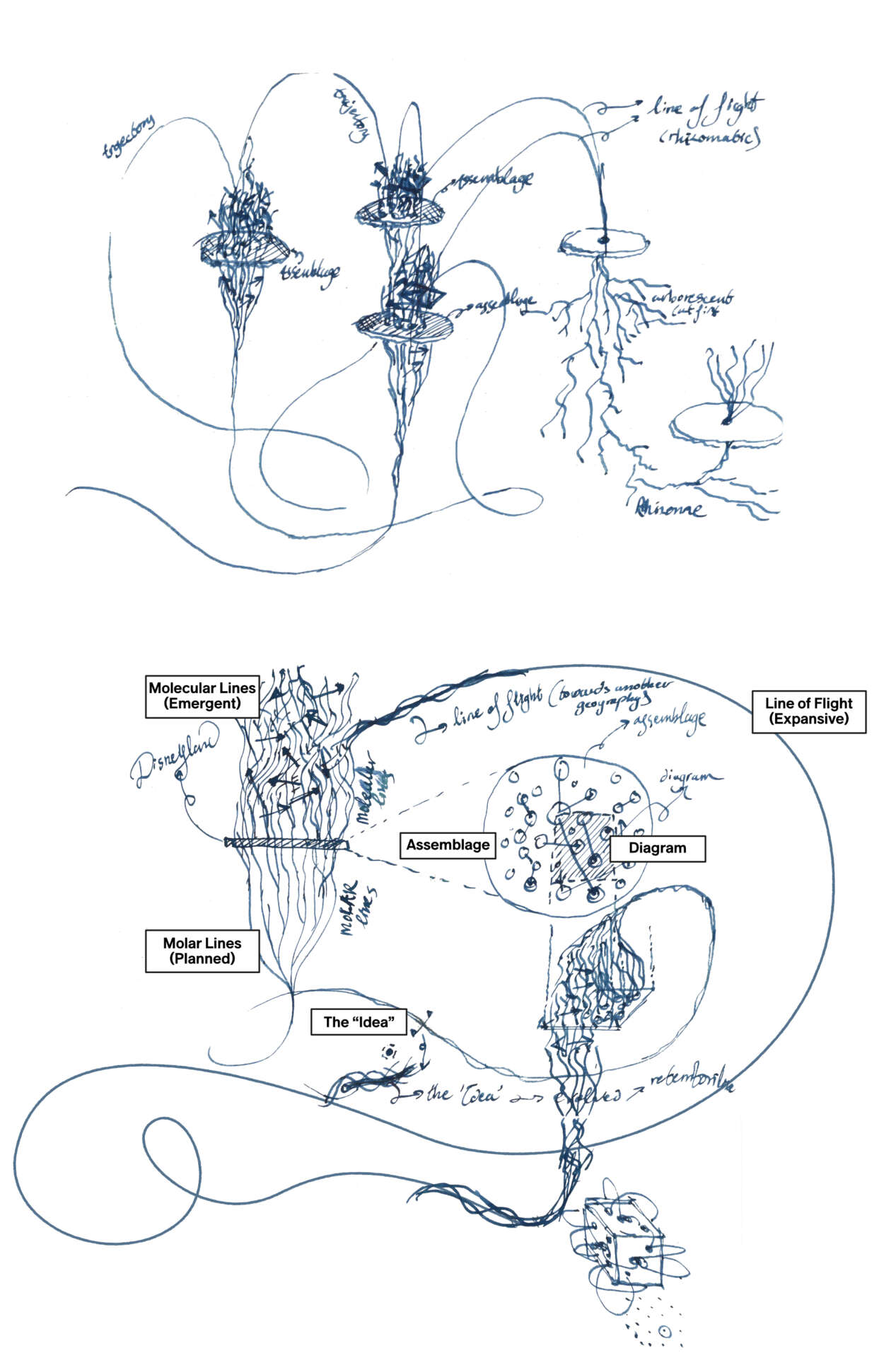
Figure 6: Attributes and their Parameters: individual diagrams per Attribute (top) and a dynamic constellation as a single snapshot (bottom). The dynamic relationship between Attributes and Parameters generates varying diagram constellations that structure and guide the mapping process. Diagrams by Joran Kuijper, 2026.
Mapping the Three Trajectories
The mapping practice is structured around the three simultaneously operating trajectories, each corresponding to a distinct analytical operation and producing a specific form of spatial knowledge. Together, these mappings articulate the diagram of L’Agencement Disneyland revealing how Disneyland stabilizes, varies, or mutates.
Mapping the Planned Trajectory addresses territorialized and coded spatial orders through stratigraphic and comparative spatial analysis. It is operationalized through tracing. By juxtaposing heterogenous elements, these mappings reveal how Disneyland’s spatial order is stabilized. What can be known through these maps is how reassurance, control, and legibility are a spatial product and are subsequently are spatially produced, maintained, and normalized.
Mapping the Emergent Trajectory addresses variations and deviations defined by a (sub)set of forces. It is operationalized through mapping. This trajectory allows for processes of de- and reterritorialization within the assemblage, but without escaping it. Rather than producing morphological representations, these mappings register intensities, frictions, and (in)formal practices as they occur within Disneyland. What can be known through these maps is how prescribed spatial narratives interact with (un)expected variations within Disneyland’s controlled environment.
Mapping the Expansive Trajectory addresses lines of flight through which spatial logics escape the assemblage, followed by processes of reterritorialization in new spatial contexts, mostly beyond, but also within Disneyland’s physical boundaries. It is operationalized through producing. This trajectory constitutes the condition through which de- and reterritorialization become possible. Mapped element-force relations become productive as they mutate into the world beyond Disneyland, such as resorts and urban developments. What can be known through these maps is how Disneyland’s spatialities translate across contexts, cause creative transformation and metamorphosis, and are ultimately recaptured through capital, branding, and archetypification.
- Assemblage is the English translation of the original word Agencement used by Deleuze and Guattari.
- “The Happiest Place on Earth” and “Discover a place that has all the happy you never knew could exist—so you’re a new kind of happy every time you visit” (Discover Your Happiest Place on Earth | Disneyland Resort, 2026).
- Like the Barbarians, see (Deleuze and Guattari, 1987, p. 222)
- As the opposite of the initial capturing done by the assemblage.
- This touches upon the 4th method (Peter Gall Krogh, Thomas Markussen and Anne Louise Bang, 2015), Expansive: “Mapping new areas” in not a particular order. It is about widening the perspective, not deepening the knowledge.
- See section Disneyland is Real and Imaginary.
- See section Disneyland as a Functioning Assemblage.
- Simplified: “[…] maps are generative, not illustrative” (Paez, 2019, p. 25).
Literature
Baudrillard, J. (1994) Simulacra and Simulation. Translated by S.F. Glaser. Ann Arbor: The University of Michigan Press (The Body, in Theory).
Corner, J. (1999) ‘The Agency of Mapping: Speculation, Critique and Invention’, Mappings. Reaktion Books, pp. 231–252.
Crampton, J.W. and Krygier, J. (2006) ‘An Introduction to Critical Cartography’, ACME: An International Journal for Critical Geographies, 4(1), pp. 11–33. Available at: https://doi.org/10.14288/ACME.V4I1.723.
Deleuze, G. and Guattari, F. (1987) A Thousand Plateaus: Capitalism and Schizophrenia. 12. print. Translated by B. Massumi. Minneapolis: University of Minnesota Press.
Discover Your Happiest Place on Earth | Disneyland Resort (2026). Anaheim, California. Available at: https://disneyparks.disney.go.com/au/disneyland/your-happiest-place-disney/ (Accessed: January 26, 2026).
Google (2024) ‘Anaheim’, Mountain View, CA: Google LLC. Available at: https://earth.google.com/web/ (Accessed: November 24, 2024).
Harley, J.B. (1989) ‘Deconstructing the Map’, Cartographica: The International Journal for Geographic Information and Geovisualization, 26(2), pp. 1–20. Available at: https://doi.org/10.3138/E635-7827-1757-9T53.
Olsberg, N. (1997) ‘Foreword’, in K.A. Marling (ed.) Designing Disney’s theme parks: The Architecture of Reassurance. Paris – New York: Flammarion, pp. 9–11.
Paez, R. (2019) Operative Mapping: The Use of Maps As a Design Tool. 1st ed. New York, Barcelona: Actar Publisher.
Parr, A. (2010) The Deleuze Dictionary. Revised edition. Edinburgh: Edinburgh University Press.
Peter Gall Krogh, Thomas Markussen and Anne Louise Bang (2015) ‘Ways of Drifting – 5 Methods of Experimentation in Research through Design’, in Amaresh Chakrabarti (ed.) Research into Design Across Boundaries Volume 1: Theory, Research Methodology, Aesthetics, Human Factors and Education. New Delhi: Springer India (Smart Innovation 34), pp. 39–50. Available at: https://doi.org/10.1007/978-81-322-2232-3.
Smith, D.W. (2012) Essays on Deleuze. Edinburgh: Edinburgh University Press.
U.S. Geological Survey (1965) ‘Anaheim.’, Denver, CO: U.S. Geological Survey. Available at: https://ngmdb.usgs.gov/topoview/viewer/#14/33.8080/-117.9290 (Accessed: November 25, 2024).
Venturi, R., Scott Brown, D. and Izenour, S. (1972) Learning from Las Vegas. Facsimile edition. Cambridge, Massachusetts: The MIT Press.
Wood, D. (1992) The Power of Maps. New York London: The Guilford Press (Mappings).