
Designing Post-Taurine Futures for Mediterranean Spain
Introduction
Bous al carrer (bulls on the street in Valencian) is a four-century-old tradition of running bulls through urban streets (Díaz Manteca & Iglesias Díaz, 1991). These events involve the release of bulls and cows along closed routes through the main streets of municipalities, where they are led, exhibited, taunted, or run by participants who are not professionally trained. In contrast to bullfighting in arenas, typical Bous al Carrer events do not culminate in the death of the animals, but they do experience chronic stress (Grau et al., 2014). Despite this, the tradition continues to hold considerable cultural and social significance in Mediterranean Spain, particularly within Valencian society. These celebrations are the central feature of most Festes Patronals (local festivities held in honour of a town's patron saint), attracting large crowds of participants and spectators, fostering community bonds, and temporarily transforming central urban spaces into pedestrianised zones dedicated to communal celebration at the expense of animal welfare (Delgado, 2003). In the province of Castelló, 124 out of 136 municipalities host these events, which last from 2 to 10 days. Right before that, the whole city centre changes its atmosphere: streets are pedestrianised, and the taurine infrastructure is assembled to receive spectators and animals.
This research essay explores how this infrastructure has evolved through history and how investigating its past reveals design threads that help develop speculative proposals, creating new imaginaries for post-taurine futures.
Ephemeral Infrastructure
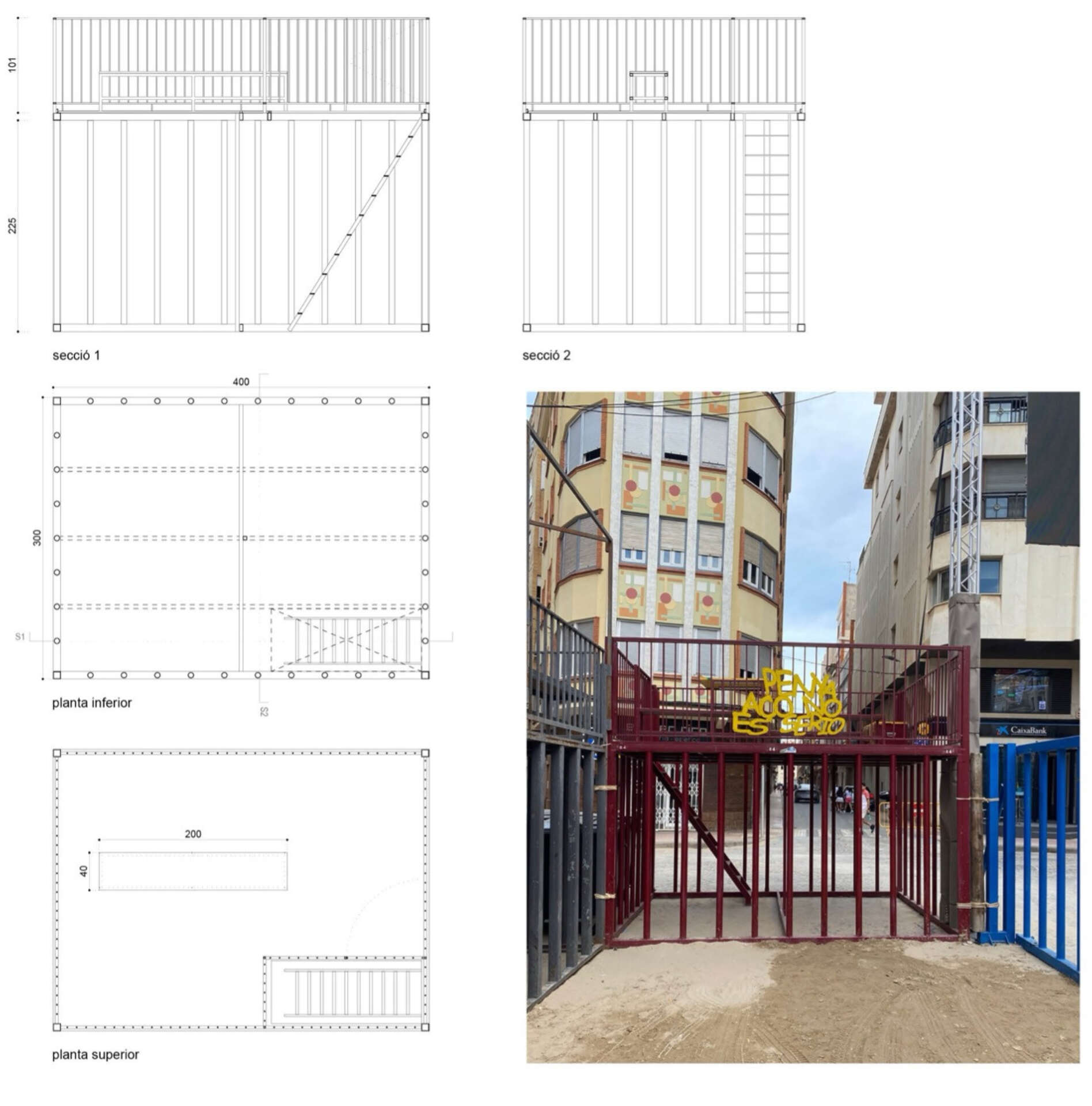
The transformation happens through precisely engineered ephemeral systems (Delgado, 2003) comprising three primary elements: modular street barriers that create enclosed circuits, ground-floor protections constructed by property owners to protect windows and doors, and steel platforms called cadafals that serve dual purposes as protection and elevated viewing positions. The cadafal constitutes the most distinctive element of this ephemeral architecture. It is a modular steel structure that follows standardised dimensions with a capacity varying from ten to twenty spectators, depending on configuration (Blasco et al., 2000). Through these three systems, the space is pedestrianised, and the venue's perimeter is closed. During celebration hours, this perimeter clearly separates safety from danger posed by a frightened animal.
Tradition Blocks Climate Adaptation
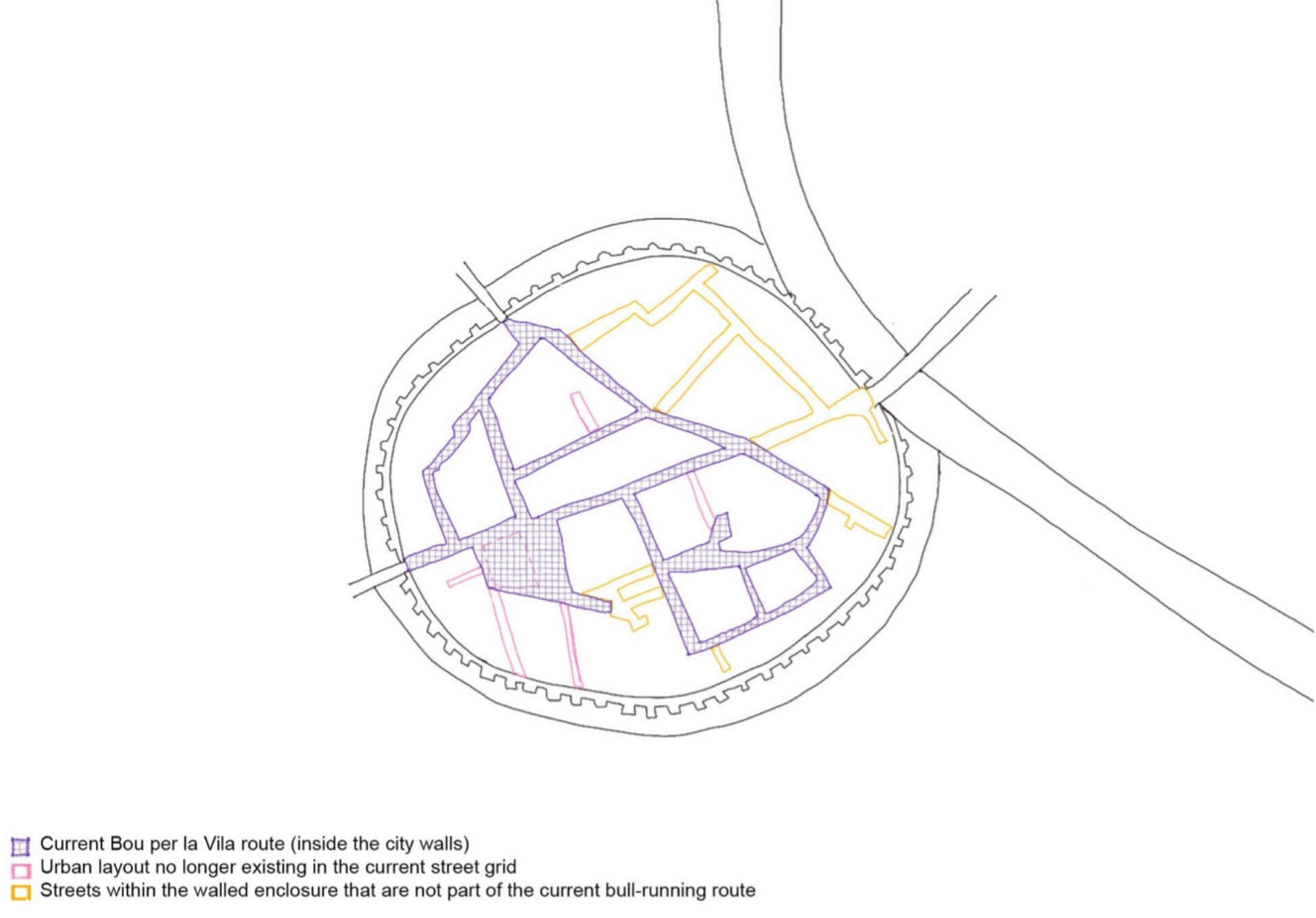
Nonetheless, the spatial consequences extend beyond festival days. Following Franco's death in 1975, there was a strong resurgence of these traditions, with municipalities becoming protective of their festivals. They represent the tradition and identity of this region, and local governments want to enhance them. However, preserving these traditions means keeping central public spaces as large, extended paved surfaces with no new fountains, trees, elements that cast shadows, or fixed urban furniture. Urban design became subordinate to taurine requirements: any remodelling of public space has to preserve the enclosure area, which is kept clear for these 10 days per year, meaning that the province's central squares have been frozen for the last decades. Landscape architectural competitions for public spaces within bull-running circuits explicitly prohibit elements that could obstruct the festival assembly. Exceptions are rare. Vila-real managed to redesign its plaça major, but the project generated significant controversy and opposition from much of the local population. Onda took a different approach, remodelling one of its main squares with movable planters and furniture that can be temporarily removed for the festivals. In most municipalities, 10 days of festival effectively determine the design of central public spaces for the remaining 355 days. The consequences are particularly acute in summer, when temperatures in some municipalities reach 40ºC. Squares remain unable to provide climate relief as long as they remain part of the bous al carrer circuit.
Why Post-Taurine?
These practices are increasingly framed by conditions of obsolescence, shaped by four key pressures:
First, climate change mitigation needs unpaved surfaces along with water, shade, and abundant greenery: precisely the opposite of what is needed for an empty arena, where sand can be spread, and nothing interferes with the activities of therodaors.
Second, demographic decline quietly erodes the social fabric that supports these events. Of the 136 municipalities in Castelló province, 83 are classified as at risk of depopulation (Dirección General de Administración Local, 2025). Fewer residents mean fewer volunteers, fewer spectators, and fewer taxpayers to cover festival costs.
Third, insurance costs climb sharply. The liability burden on local governments is considerable: minors participate ignoring the prohibition, alcohol and drug consumption is common, often cows escape from the venue and can reach anybody who is just walking on the streets, often older adults. Between 2014 and 2022, 34 deaths were attributed to bous al carrer events.
Fourth, ethical opposition to animal abuse is intensifying. While voices against animal suffering have always existed (Codina Segovia, 2023), recent prohibitions, such as Catalunya's ban on toros de lidia and the abolition of el toro de la vega, indicate a changing public awareness that is increasingly difficult to overlook.
The Paradox, Ethical Positioning and Research Question
Even though these festivals cannot persist indefinitely, they hold centuries of accumulated spatial knowledge: how communities collectively organise and hierarchise space, how modular systems evolved through trial-and-error, and how assembly rituals strengthen social bonds. This research does not propose 'sustainable bullfighting' or design interventions making festivals compatible with climate adaptation while maintaining animal abuse. Such a compromise would be ethically indefensible and technically impossible, since genuine climate mitigation cannot rely on removable infrastructure. This work operates from the premise that converging pressures make the disappearance of taurine festivals increasingly probable. By projecting intangible post-taurine futures through design speculation, the research creates distance from tradition-attachment, enabling communities to imagine transformation without experiencing it as total loss and create spaces for discussion and debate (Dunne and Raby, 2013). From this perspective, the research asks: What spatial knowledge and modular systems developed through centuries of bous al carrer can be reconfigured to imagine new collective uses of public space once these practices disappear?
Figure 1: Image of an enclosure made out of round woods and horse-drawn carriages in a pause of a bous al carrer event in Càlig. Unknown author. Arxiu Personal de Sofia Querol.
Research-by-Design Methodology: A Two-Phase Trajectory
This investigation works through two connected phases that treat drawing, mapping, and speculation as ways of generating knowledge rather than just illustrating it (Frayling 1994).
Phase 1: Historical Mapping as Design Research
The first phase reconstructs how communities have developed spatial solutions balancing safety, spectacle, and participation. This work combined archival research (historical photographs, municipal records, festival programs, regional media) with collective mapping and extended interviews with key informants. Afterwards, there was an intense period of on-site observation during festivals, including assembly and disassembly, mapping in situ and post-fieldwork analytical drawing. This served to gather information and test hypotheses related to taurine perimeters, infrastructure evolution, symbolic value of space and assembly sequences. Most of this research took place in Borriana, a small city of 35,000 inhabitants that is proud of the quality of its bull-running tradition.
Historical research revealed several key spatial logics relevant for this research:
First, morphological permanence. Despite infrastructural evolution, the spatial configuration of the primary circuit remained stable, following street hierarchies established centuries ago.
Second, an infrastructural trajectory from improvisation to standardisation. Communities initially blocked streets with systems of round woods. Afterwards, horse-drawn carriages were used to close the perimeter and simultaneously create a viewing platform for passive audiences. Later on, the available space was divided into identical plots of 3x3m to place the new platforms made from structural round woods and boards. During the 80s, the structures we know today were implemented: standardised steel modules, precisely engineered to certified specifications. This evolution from reappropriated objects to specialised systems shows how ephemeral practices solidify and how collective evolution goes towards standardisation and industrialisation through regulations.
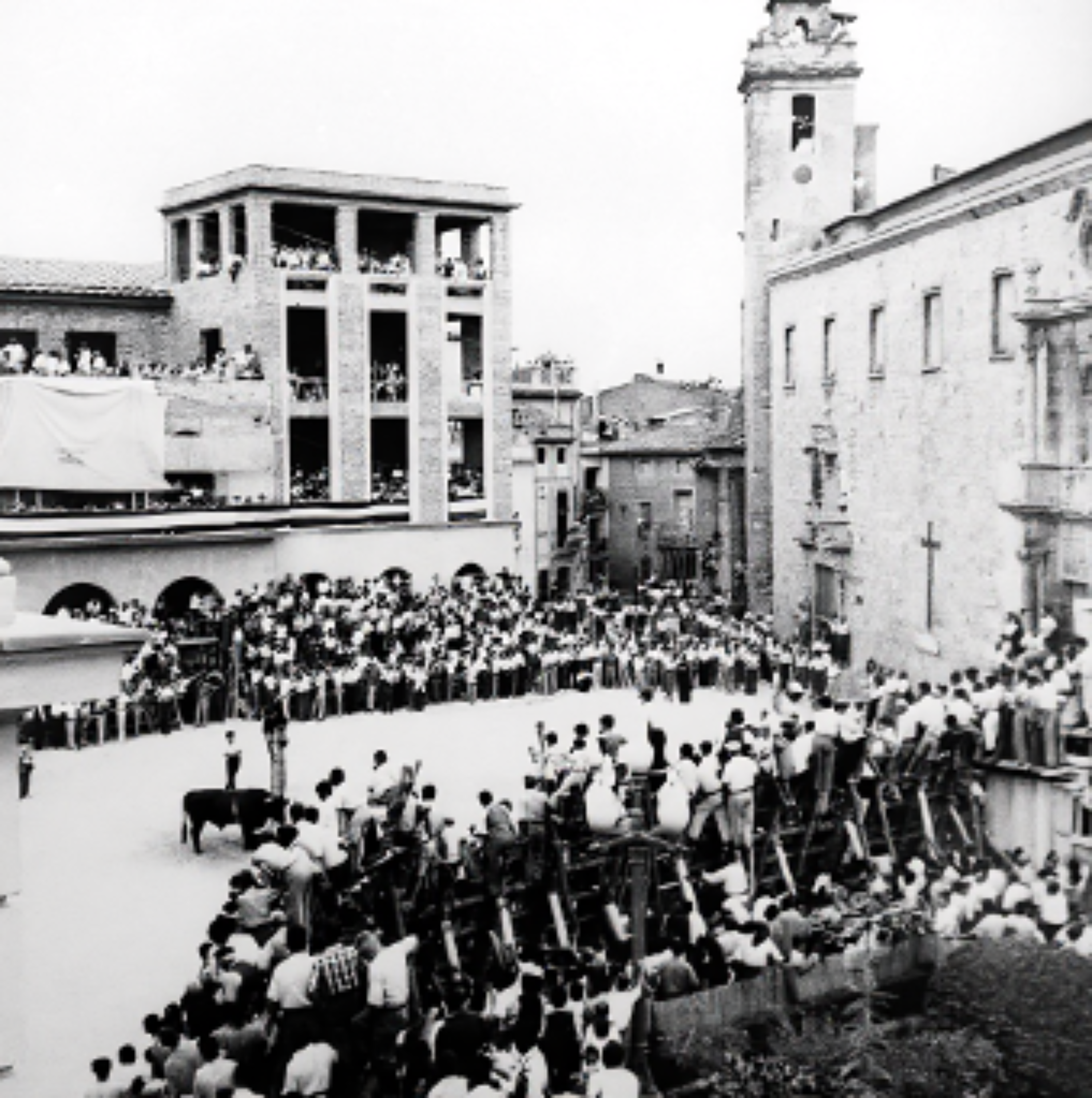
Figure 2: Image of Plaça Major blocked with wooden barriers in a bous al carrer event. Borriana, 1950s. Unknown author. Arxiu Municipal de Borriana.
Third, the accumulated spatial knowledge. Communities have developed a sophisticated understanding of space through centuries of observation. This includes microclimate awareness: the canonical sol o sombra (sun or shade) that determines seating prices in professional bullrings also operates here: locals know precisely how sunlight moves across the main square throughout the day. Strategic sightlines matter: participants know which cadafal offers the best views of the entire enclosure. Topographical variations are understood through experience: bulls invariably slip on curved streets with the finest slope. This collective environmental intelligence has been tested and refined over generations, and the knowledge is directly applicable to climate adaptation challenges.
Fourth, collective assembly choreographies. Infrastructure requires coordinated labour involving municipal workers, volunteer crews, and cadafals owners, all following protocols about timing, responsibility, and spatial organisation. These assembly traditions then community bonds through shared physical labour, shared equipment, and collective competence (Delgado, 2003).
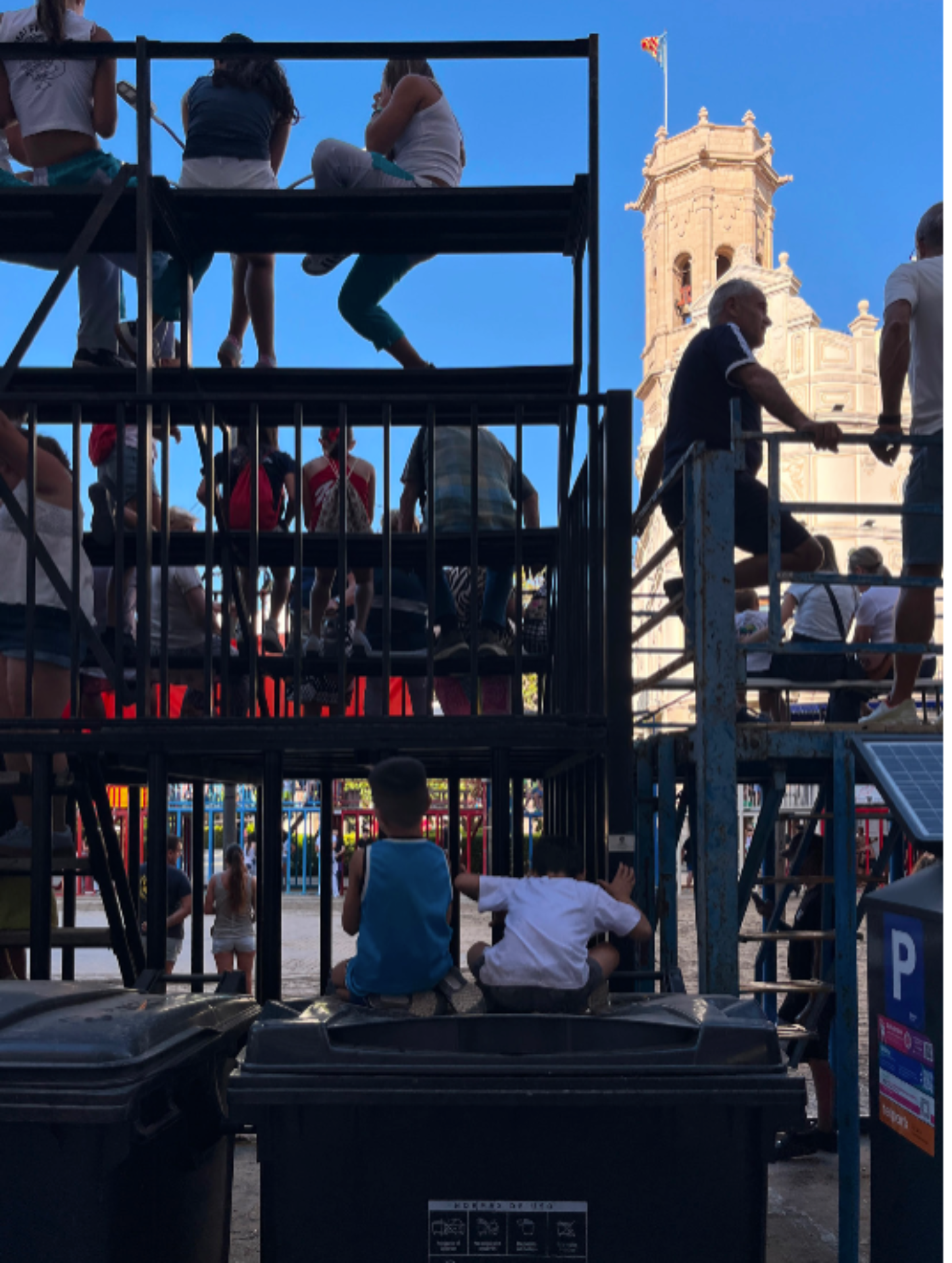
Figure 3: Two young boys climbing onto a bin to see through the bars during the bull-running in El Pla, Borriana. Photograph by Beatriz Alés-Gregori, 2025.
Fifth, barriers create a gender-related triple-height system: ground-level protection, mid-level platforms (cadafals’upper floor), and building facades transformed into elevated viewing positions. This vertical stratification produces distinct participation zones differentiated by gender, age, and physical ability. Men dominate the ground level, where direct contact with bulls confers social status (Mira, 1976, Gil-Cortés 2024). Women and children typically occupy the safer mid-level cadafals or upper balconies. At the periphery, people who cannot access the interior for mobility reasons gather—mothers with strollers, wheelchair users and others. This spatial stratification materialises social hierarchies around risk, gender and participation.
Sixth, the presence of animals in the urban environment. Several informants note that these festivals are among the few occasions when urban residents come into contact with non-domestic fauna. This observation becomes more relevant as the disconnect between urban populations and natural settings grows.
Seventh, the complex position allocation system. Borriana operates a rotation mechanism where 90 cadafals shift 15 positions annually, completing a six-year cycle that ensures equitable access to all locations (Torralba, J., personal communication, 2024). The 15 rotation positions correspond to the street's least visible spots, preventing consecutive placements in disadvantaged areas. Other villages employ annual auctions instead.
Phase 2: Speculative Design as Research
The second phase uses design speculation to test whether spatial intelligence documented in Phase 1 can be extracted from its taurine function and reconfigured toward alternative collective practices to open up new perspectives (Dunne and Raby, 2013).
Proposal 1: Rethinking Animal Presence. The cadafals and barriers could support nesting structures for swallows, bat boxes, and habitat corridors for small mammals. The venue has been proven to function as a pedestrianised zone during festivals, so that it could remain that way. There, grazing animals, such as bulls and cows, maintain the intense greenery in central areas. Instead of instrumentalising animals for entertainment, the infrastructure becomes a protection. Urban wildlife coexists with human use.
Proposal 2: Climate Adaptation. The spatial intelligence governing the distribution of shade and topographical variation already exists in festival practice. As summers intensify, this knowledge could inform collective cooling strategies. This proposal reconfigures barrier modules as vertical structure systems that support climbers and drought-resistant Mediterranean species, providing shade and evaporative cooling during warm months. The cadafals function as shading devices with adjustable canopies. Topographical knowledge guides the placement of water collection ponds in areas where runoff naturally accumulates. Communities still gather to transform their plazas, but toward thermal comfort rather than animal spectacle.
Proposal 3: Rotation as Commoning Practice
The proposal extends rotation logic to ongoing public space management. The modular division of space accommodates temporary uses that cannot find a place elsewhere or that benefit from extreme visibility at the main public square. Rotation enables fair distribution. Community groups assemble their program using shared components. The collective competence and social bonding that current assembly traditions generate persist, but they no longer build cadafals; they assemble 3x3m containers made out of circular materials.
Proposal 4: Redistributing Gendered Space
The proposal reconfigures existing spatial hierarchies. Platforms support activities with broader participation demographics, such as community theatre, collective dining, and intergenerational skill-sharing workshops. Local workshops with non-men users develop how platforms should be designed, since until now they have been developed entirely by male festival participants. Cadafal materiality and assembly procedures are revised to be accessible to anybody. Assembly choreographies explicitly rotate responsibilities between genders rather than reproducing male-dominated patterns.
Conclusion
Bous al carrer attracts large crowds to the municipality's most central space for extended periods, sometimes for entire days. This sustained collective presence generates observational knowledge that municipalities without such enduring social events lack. The findings identify transferable patterns: modular systems for temporary space transformation, rotation mechanisms that distribute access and responsibility, and embedded environmental knowledge applicable to climate adaptation.
The methodology combined historical reconstruction through archival research and fieldwork with speculative design proposals. Festival documentation, assembly observations, and key informant interviews mapped the evolution of infrastructure and spatial logics. Speculative proposals tested whether documented intelligence could function independently from taurine origins.
Design speculation functioned as an analytical method. Proposing functional transformation exposed power structures in spatial hierarchies and tested boundaries of cultural attachment against environmental and social necessity. The methodology establishes a framework for engaging heritage practices facing obsolescence through active investigation rather than passive abandonment or unchanged preservation. The next step is to work together with users and participants of these activities to test if it opens up their perspectives towards different future scenarios.
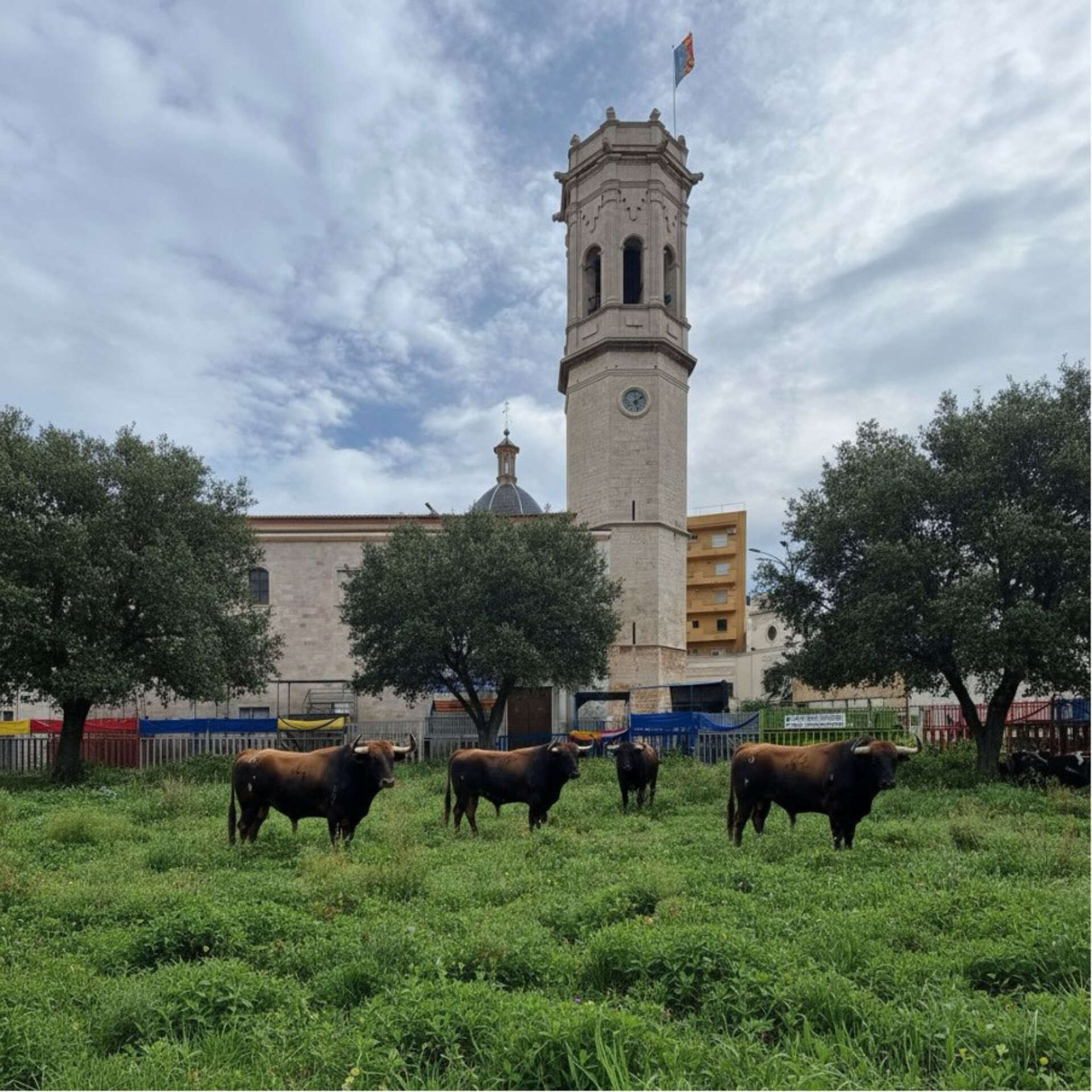
Figure 6: Speculative image of Plaça Major in a post-taurine event. Borriana, Original photo by author, collage by nanobanana AI, 2025.