
Fragmented Trajectories Visualising Ideology, Memory and Spatial Re-Inscription in Skopje
The central area of Skopje does not constitute a cohesive, gradually developed urban entity; instead, it has evolved through recurrent ruptures, external interventions, and unresolved ideological transitions. The point is therefore not to restore a single image of the city, but to trace how spatial meanings persist, shift, and return across political and architectural moments. Over the past two centuries, various planning paradigms have sought to reshape spatial configurations and redefine political authority, memory, and representation. These paradigms frequently overlapped, diverged, or conflicted, leaving discernible traces within the urban fabric. As a result, fragmentation has become the dominant mode shaping Skopje’s urban reality. Early modernist efforts introduced rational planning to stabilise statehood and articulate a modern societal identity within the Kingdom of Yugoslavia, with architecture serving to organise conceptual clarity, institutional order, and civic identity in the post-Ottoman context. The 1963 earthquake abruptly disrupted this trajectory, both materially and symbolically. Subsequent reconstruction, led by the United Nations and Kenzo Tange, situated Skopje within an international narrative of solidarity and socialist advancement. Urban planning during this era pursued large-scale recovery and a progressive vision, projecting unity and order through plans and models, despite uneven implementation. In the post-socialist era, the Skopje 2014 initiative utilised architecture to generate new symbols, emphasising contentious monuments, novel historicist styles, and dramatic visual effects to construct narratives of contested ideology, cultural continuity, and political legitimacy. Rather than integrating previous urban and architectural layers into collective memory, these interventions relied on selective symbolism and the overwriting of the socialist past. Earlier narratives were neither fully erased nor meaningfully reconciled, but neutralised, displaced, or made harder to access except indirectly, comparatively, or diagrammatically. Consequently, public spaces became saturated with symbolic content while remaining experientially fragmented, functioning as sites of ideological display, memory, and ambiguity. In this context, coherence arises through ongoing reinterpretation rather than linear progression.
Within this fragmented context, ideology is enacted primarily through spatial form and visual order rather than explicit iconography. Architectural representation establishes regimes of visibility that determine what is legible, what recedes, and what is rendered invisible. Ideological content becomes naturalised through aesthetic and spatial conventions, embedding political meaning within ostensibly self-evident forms. Successive regimes have reorganised perception by recalibrating spatial hierarchies, axes, and symbolic focal points, thereby shifting the distribution of visibility and invisibility. Consequently, Skopje’s centre functions as a site where ideological authority is continually asserted, contested, and reformulated through spatial means.
Diagrammatic artefacts and methodological calibration
This condition is addressed through visualisation, a design-driven epistemic practice. Drawing is employed not to illustrate predetermined conclusions but to foster knowledge through spatial reasoning. Diagrams operate as analytical devices that construct relational fields in which ideological, temporal, and spatial dimensions are examined simultaneously. Diachronic mappings trace sequences of transformation while deliberately resisting linear developmental narratives, registering moments of interruption, redirection, and coexistence to accommodate multiple trajectories within a single analytical frame. Layered diagrams superimpose planning paradigms, representational regimes, and symbolic programmes, preserving collision and misalignment as analytical material rather than resolving them into synthesis. Interpretative overlays isolate residual and suppressed narratives by amplifying traces that persist beneath dominant representations, thereby revealing processes of ideological neutralisation and mnemonic displacement. Sequential drawings extend this analysis into the experiential domain, examining how movement, perception, and spatial orientation are reorganised across historical periods. Within this methodological framework, architectural projects are considered fragments embedded within broader trajectories rather than isolated case studies. Nikola Dobrović’s unrealised project for Skopje occupies a pivotal position in this analysis. Conceived within an early modernist context, the project articulated a rationalist vision of monumental urban order, grounded in spatial hierarchy, institutional clarity, and ideological expression. As established in prior analyses of Dobrović’s work, monumentality in this context is achieved through spatial sequencing and organisational logic rather than representational excess. The project’s non-realisation suspended this trajectory, leaving it neither materially integrated nor discursively resolved. When examined diagrammatically, Dobrović’s proposal functions as a residual inscription, representing a latent spatial logic that precedes subsequent ideological reconfigurations while remaining structurally incompatible with them. The diagram does not reconstruct the project as an architectural solution but situates it within a temporal field shaped by rupture, interruption, and re-inscription. Thus, the fragment serves as an operative analytical unit for investigating broader spatial trajectories.
Figure 1: Urban matrices of Skopje from 1918 to 2025. Graphic by the author, 2026
From this perspective, modernist rationalisation, socialist reconstruction, and post-socialist symbolic retrofitting represent interdependent yet contradictory efforts to stabilise meaning, regulate visibility, and construct collective memory. Fragmentation functions simultaneously as an empirical condition, a methodological approach, and a research outcome. Rather than seeking narrative closure, this research foregrounds discontinuity as the principal means by which ideological transformation becomes spatially legible. Visualisation serves as an active agent in this process, articulating competing trajectories without reducing them to a singular narrative. Skopje is thus not characterised as a failed urban project, but as a field shaped by ongoing negotiation among ideology, memory, and spatial form. Early modernist initiatives in Skopje introduced rationalist spatial frameworks to articulate statehood, administrative order, and modern social relations. Architecture functioned as a mediating apparatus between political ideology and spatial form, translating abstract principles of order, hierarchy, and collectivity into urban structure. This trajectory was abruptly interrupted by the 1963 earthquake, which produced a radical rupture in both material and symbolic terms. Post-earthquake reconstruction, coordinated by the United Nations and articulated through Kenzo Tange’s megastructural proposals, repositioned Skopje within an internationalist narrative of solidarity and socialist modernisation. Urban planning operated at the scale of comprehensive systems, projecting a vision of collective recovery and future-oriented progress. Plans, diagrams, and visualisations played a crucial role in stabilising this vision, producing an image of ideological coherence that exceeded the uneven realities of implementation and everyday spatial practice. The post-socialist period introduced a distinct representational regime. Skopje 2014 mobilised architecture as an explicit symbolic apparatus, employing monumentalisation, stylistic historicisation, and scenographic saturation to construct narratives of cultural continuity and national legitimacy. Instead of combining previous spatial layers into a single urban memory, these interventions shifted visibility and meaning by carefully selecting and overwriting symbols. Earlier narratives were neither fully erased nor meaningfully reconciled, but neutralised through representational excess. As a result, central public spaces became dense with symbols while remaining experientially disjointed, functioning simultaneously as sites of ideological display and spatial disorientation. Fragmentation thus emerges not as an accidental outcome, but as the dominant condition through which Skopje’s urban reality is produced and negotiated. In this context, ideology operates through spatial form and visual order rather than solely through explicit iconography. Architectural representation structures regimes of visibility that determine what becomes legible, what is marginalised, and what is rendered invisible. Ideological content is naturalised through aesthetic and spatial conventions, embedding political meaning within seemingly self-evident forms. Successive regimes have reorganised perception by reconfiguring spatial hierarchies, axes, and symbolic focal points, thereby shifting the distribution of visibility and invisibility. The city’s centre thus functions as a terrain where ideological authority is repeatedly asserted, challenged, and reformulated through spatial means.
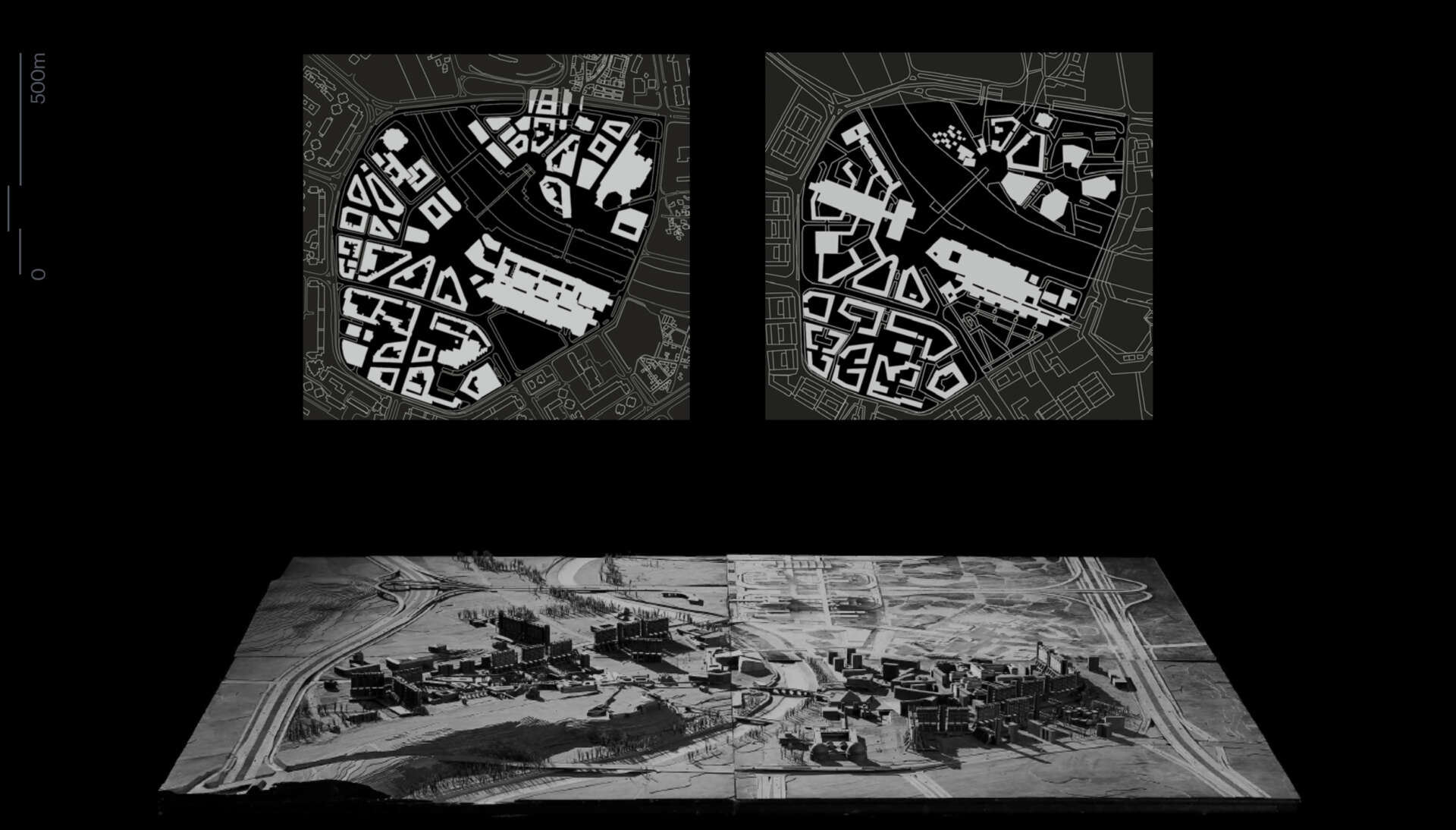
Figure 2: Comparative urban plans and post-earthquake (1965 plan and the current state in 2025) reconstruction model of Kenzo Tange’s team project.Graphic by the author, based on Kenzo Tange’s Skopje Urban Plan published in The Japan Architect, 1967.
Drawing is utilised not as a supplementary communication tool for textual analysis, but as a primary analytical operation through which spatial relations, ideological tensions, and temporal overlaps are actively constructed and examined. Diagrams function as operative devices that organise heterogeneous material into relational fields without resolving inherent contradictions. Diachronic mappings trace sequences of transformation while intentionally resisting linear narratives of progress or decline. Instead, they register moments of interruption, redirection, and coexistence, demonstrating how spatial form is shaped by discontinuous trajectories rather than stable developmental logics. Layered diagrams operate through superposition, situating planning paradigms, representational regimes, and symbolic programs within a shared visual field. Collision and misalignment are preserved as analytical material, allowing ideological tensions to remain visible. Interpretative overlays isolate residual and suppressed narratives by selectively amplifying traces that persist beneath dominant representations, thereby exposing processes of ideological neutralisation and mnemonic displacement. Sequential drawings extend this analysis into the experiential domain, tracing how movement, orientation, and spatial perception are reorganised across historical moments. Collectively, these visual operations transform fragmentation from a descriptive diagnosis into a productive methodological framework.
Within this analytical framework, architectural projects are considered as fragments rather than complete case studies. Nikola Dobrović’s unrealised project for Skopje occupies a critical position in this context. Conceived within an early modernist horizon, the project articulated a rationalist vision of monumental urban order grounded in spatial hierarchy, institutional clarity, and ideological articulation. As established in previous analyses of Dobrović’s work, monumentality in this context operates through spatial sequencing and organisational logic rather than representational excess. The project’s non-realisation suspended this trajectory, leaving it neither materially integrated nor discursively resolved. When examined diagrammatically, Dobrović’s proposal functions as a residual inscription: a latent spatial logic that precedes subsequent ideological reconfigurations while remaining structurally incompatible with them. The diagram does not reconstruct the project as an architectural solution but situates it within a temporal field shaped by rupture, interruption, and re-inscription. This approach establishes a methodological precedent for interpreting unrealised or marginalised projects as active analytical agents rather than historical footnotes. Through this lens, modernist rationalisation, socialist reconstruction, and post-socialist symbolic retrofitting are understood as interdependent yet contradictory attempts to stabilise meaning, regulate visibility, and construct collective memory. Fragmentation operates simultaneously as an empirical condition, a methodological stance, and a research outcome. Rather than seeking synthesis or narrative closure, the research foregrounds discontinuity as the primary mode through which ideological transformation becomes spatially legible. Architectural visualisation emerges as an active agent in this process, capable of exposing tensions, sustaining complexity, and articulating competing trajectories without resolving them into a unified narrative. Seen in this light, trajectories are not introduced as an external framework, but emerge from the material itself. In Skopje, they appear as deferred plans, incomplete reconstructions, unrealised modernist propositions, symbolic rewritings, and spatial structures that continue to operate after their original political horizon has shifted. The research, therefore, follows these overlapping movements without reducing them to a single chronological narrative. This also situates the essay within a broader doctoral inquiry into how ideology remains spatially legible across architecture, urbanism, and the post-Yugoslav transformation of political space. Skopje thus appears not as a failed urban project, but as a field structured by ongoing negotiation among post-socialist ideology, memory, architectural and spatial form.
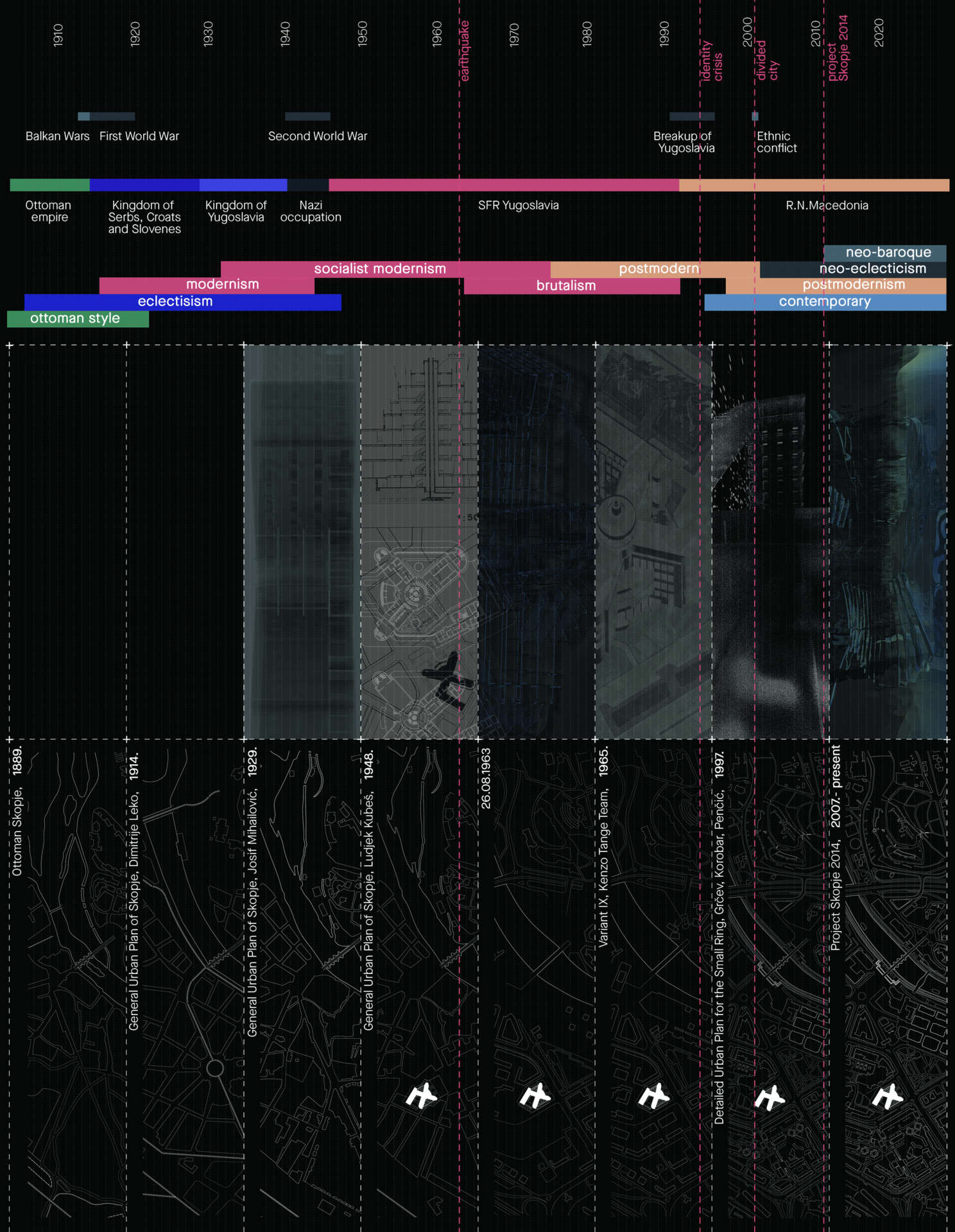
Figure 3: Diachronic and ideological trajectories of Skopje — Nikola Dobrović Sequence. Graphic by the author, 2024.
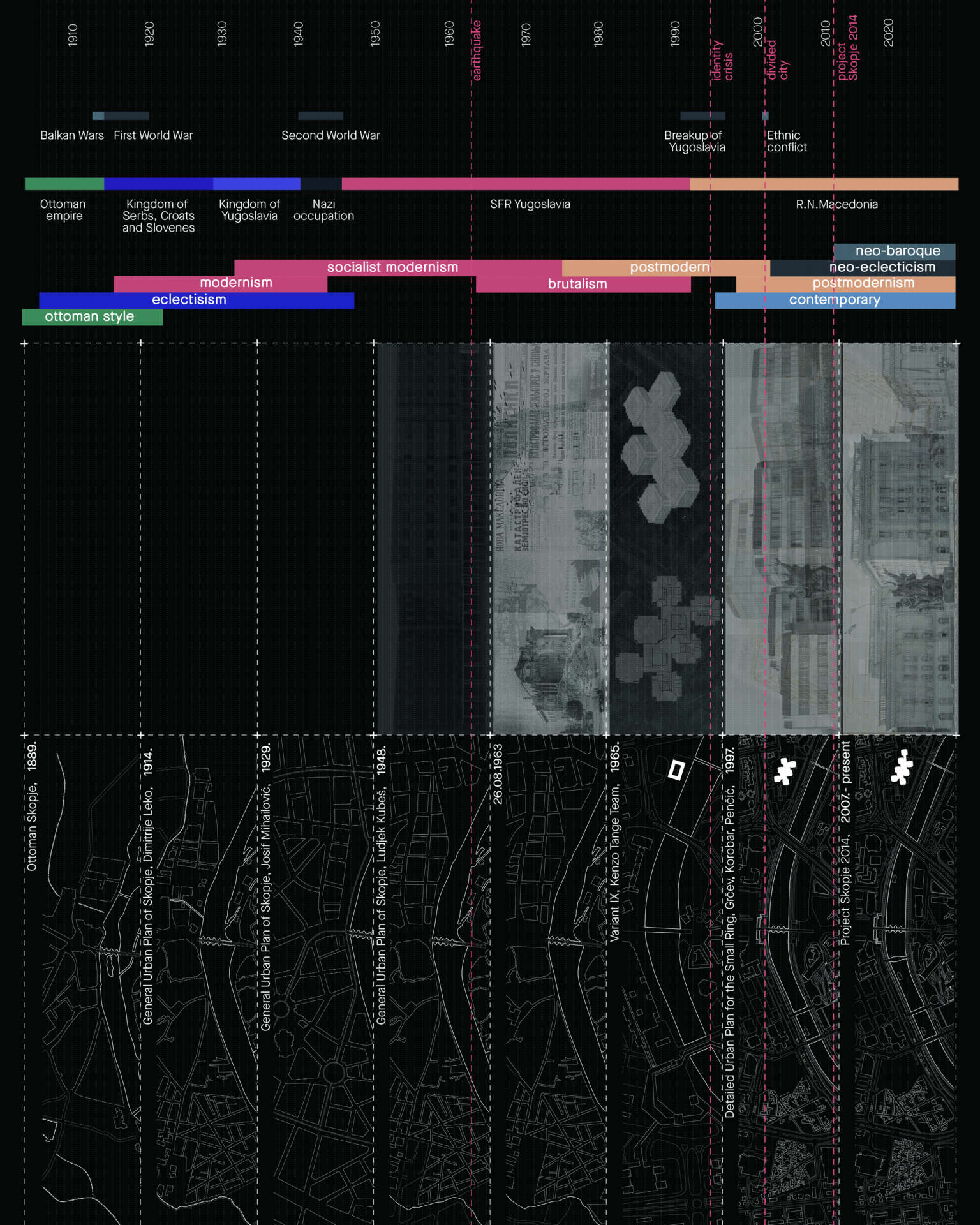
Figure 4: Diachronic and ideological trajectories of Skopje — Central Committee CK KPJ Sequence. Graphic by the author, 2026.
Literature
Allen, S. (1998) ‘Diagrams Matter’, ANY: Architecture New York, 23, pp. 16–19.
Allen, S. (1999) Points and Lines: Diagrams and Projects for the City. New York: Princeton Architectural Press.
Althusser, L. (1971) ‘Ideology and Ideological State Apparatuses’, in: Lenin and Philosophy and Other Essays, New York: Monthly Review Press, pp. 127–186.
Barthes, R. (1972) Mythologies. Translated by A. Lavers. New York: Hill and Wang.
Bovelet, J. (2010) Drawing as Epistemic Practice in Architectural Design, Footprint, 7, pp. 75–84.
Dobrović, N. (1998) ‘Pokrenutost prostora – Bergsonove “Dinamičke sheme” – nova likovna sredina’, in Perović, M. (ed.) Dobrović. Beograd: Urbanistički zavod, pp. 38–51.
Eagleton, T. (1990) The Ideology of the Aesthetic. Oxford: Blackwell.
Foucault, M. (1977) Discipline and Punish: The Birth of the Prison. Translated by A. Sheridan. New York: Vintage Books.
Jackson, M. L. (2022) Diagrams of Power: Benjamin and Foucault. Cham: Springer.
Lefebvre, H. (1991). The Production of Space. Translated by D. Nicholson-Smith. Oxford: Blackwell.
Perović, M. (ed.) (1998) Dobrović. Beograd: Urbanistički zavod.
Rancière, J. (2004) The Politics of Aesthetics: The Distribution of the Sensible. Translated by G. Rockhill. London: Continuum.
Schoonderbeek, M. G. H. (2015) Place–Time Discontinuities: Mapping in Architectural Discourse. Delft: TU Delft.
Stanek, Ł. (2020) Architecture in Global Socialism: Eastern Europe, West Africa, and the Middle East in the Cold War. Princeton, NJ: Princeton University Press.
Stierli, M. and Kulić, V. (eds.) (2018) Toward a Concrete Utopia: Architecture in Yugoslavia, 1948–1980. New York: The Museum of Modern Art.
Tange, K. (1965) Report on the Plan for Skopje. Tokyo: Kenzo Tange Laboratory.
Tschumi, B. (1994) Event-Cities. Cambridge, MA: MIT Press.
Žižek, S. (ed.) (1994) Mapping Ideology. London: Verso.