OFF COURSE On Situational Overwhelm and Context Exposure
Architecture is often framed as a discipline of control and predictability, oriented toward the realization of predefined intentions. Yet practice persistently resists this linearity: every design contains irregularities, every plan harbors inconsistencies, and every construction process inevitably diverges from its projection. Mistakes are typically treated as deficits to be corrected or avoided. However, detours and adjustments are integral to learning processes, and accidents or coincidences are inherent in every form of evolution.
Furthermore, a mistake is not an objective condition but a relational one: it is a deviation from an intended trajectory, shaped by cultural, social, and psychological conventions. It contains notions of inconsistency, incompleteness, and friction. For this reason, it often resonates emotionally—appearing honest, disarming, even relieving. In contrast to an “error,” understood as a systemic malfunction, or a “defect” as an inherent flaw, the “mis-take” implies the possibility of another “take.” It is precisely this unexpectedness that gives it a particular charm, tension, and effectiveness: it reveals moments of situational overwhelm, exposing the contingencies of time, constellation, and space. Processes appear as having “gone off track,” teasing interpretation and empathy.
Rather than viewing deviations as failures, the research project Meaningful Mistakes—grounded in observations of everyday moments of irritation and temporary loss of control within the design process—explores mistakes not merely as flaws, but as forces that are simultaneously disruptive and productive for spatial practice. Operating across design studios, realized projects, urban interventions, and discursive formats, it poses the question: How can engaging with mistakes recalibrate architectural perception and decision-making? And what spatial, material, and aesthetic qualities emerge, particularly in relation to broader questions of sustainability, collectivity, and resonance?
With these questions in mind, motifs and experiments explore “going off course” and design methods that treat loss of control and imperfection as integral to the process, thereby challenging conventional ideals of precision and mastery. Instead, this research examines an architectural practice that values openness, ambiguity, and poetic gaps; interrogates authorial control; and integrates open-ended approaches characterized by material resonance and reduced authorship.
Such dynamics become particularly visible in spatial production that works with existing structures whose preconditions precede and sometimes resist new interventions; in collaborative or interdisciplinary contexts where multiple intentions meet and frictions emerge; and under material constraints that require situated decision-making and exceed the capacity of linear planning. Established sequences and relationships between form, material, and production are deliberately unsettled, while affective and relational dimensions are taken seriously. A deliberate surrender to surrounding conditions or a loosening of control does not imply disorientation. Rather, imperfection and “faulty” processes are understood as preconditions for a more open, attentive, sustainable, inclusive, and adaptive architectural practice. In these contexts, irregularities multiply, and recurring patterns and procedural shifts in the design process become discernible. “Inconveniences”—material limitations, restricted resources, or situated social negotiations—are not treated as constraints to be overcome but as generative starting points.
Comparable to improvisation within defined parameters in music or dance, the observed design practice can be described as structured spontaneity. Consciously surrendering to environmental conditions does not imply a loss of orientation; rather, it involves cultivating moments of deliberate not-yet-knowing—embracing provisional, unresolved, or “still ugly” states. Another strategy for integrating uncertainty involves the use of scores or prompts—open instructions rather than fixed plans. Borrowed from performance practices, such frameworks define parameters while allowing situational variation. Especially in collaborative or collective contexts, a score that outlines possibilities rather than prescribes outcomes enables slow development, simultaneous working, doubt, and collective reflection rather than efficiency-driven production. It tolerates disorder while remaining open to users, craftspeople, materials, and temporal change. The built artifact is no longer conceived as the endpoint of a linear process but as a provisional state.
Material selection constitutes a decisive and unusual early phase, often guided by intuitive attraction or resonance. The notion of the “found object” describes an item “found (or sometimes bought) by an artist and kept because of some intrinsic interest the artist sees in it.”1 The focus shifts from executing a predetermined plan to actively engaging with available conditions. In a broader sense, as the Smithsons articulated in the early 1950s:
“Setting ourselves the task of rethinking architecture, we meant by the ‘as found’ not only adjacent buildings but all those marks that constitute remembrancers in a place and that are to be read through finding out how the existing built fabric of the place had come to be as it was… Thus the ‘as found’ was a new seeing of the ordinary, an openness to how prosaic things could re-energize our inventive activity.”2
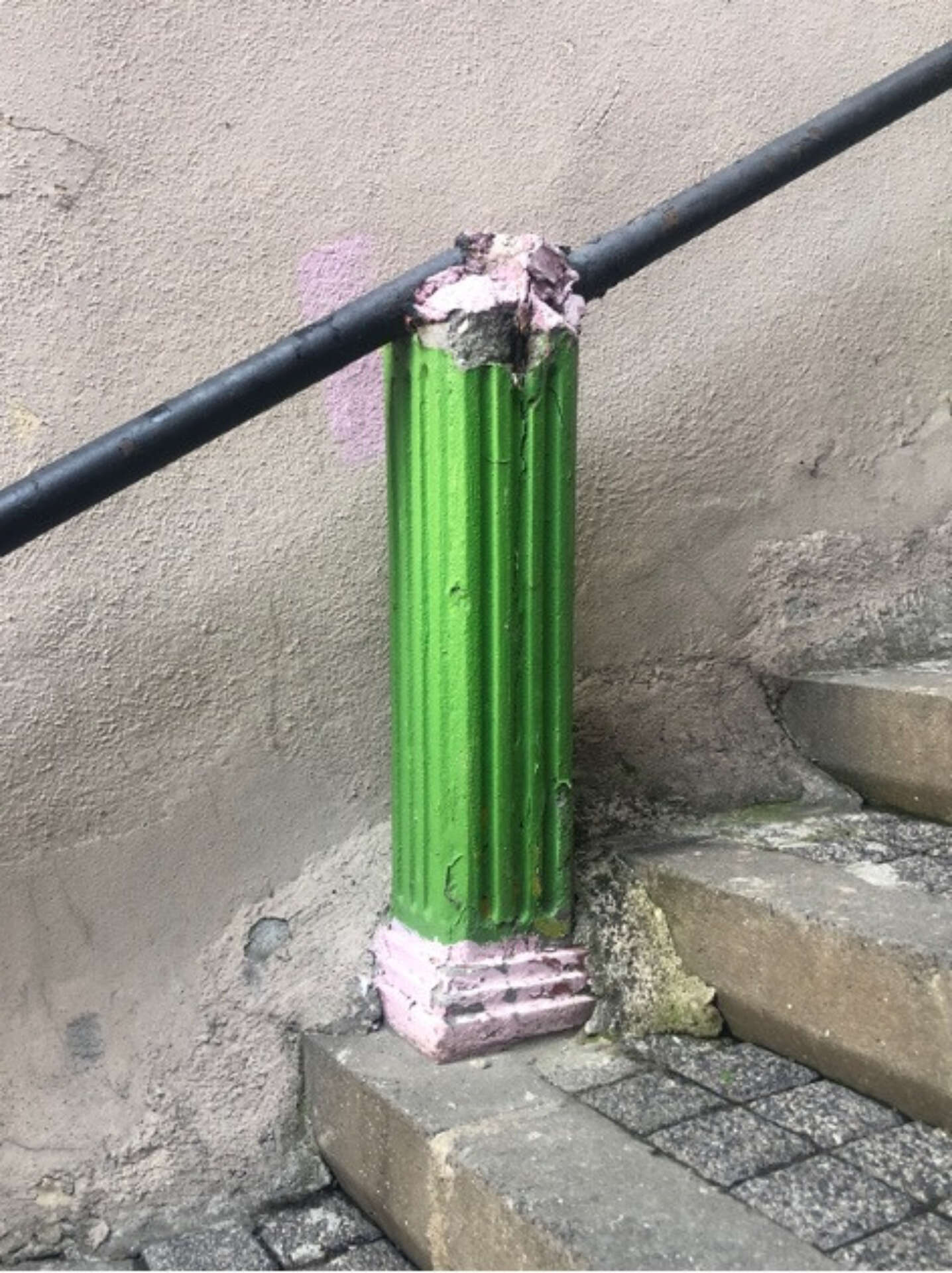
Figure 1: Everyday urban irritation, Istanbul: Found urban handrail post echoing the form of an antique column. Painted in neon green and pink, surface partially chipped, yet still structurally connecting two railings. An ordinary infrastructural element producing an unintended composition between ornament and infrastructure, where functional logic is exceeded through decay, repair, and informal intervention, 2023 ©Luise Leon Elbern
Collected materials then form what may be described as a “poetic storage”—not a rationalized inventory, but a provisional constellation of speculative potentials. This willingness to delay definitive use introduces risk, as materials may acquire function or meaning only later in the process, leading to the bricolage of idiosyncratic materials that demand situation-specific decisions. As these materials are reinterpreted and repositioned, the process oscillates between intention and response. The design begins as a curatorial act: selection, collection, reflection, anticipation, and making become intertwined. Classical notions of linearity and aesthetic coherence are thus placed under tension and ultimately destabilized.
Under such conditions, structures may emerge that are internally composed and relatively balanced, yet whose forms and expressions could not have been fully anticipated. Architecturally—particularly at the seams, joints, and collaged zones—buildings must absorb shifts, contradictions, and visual displacements. Sometimes the “mis-take” remains subtle, sometimes it is clearly legible. These specificities and tensions reveal the conditions of production; unexpected forms and spatial constellations arise. The resulting surprises or irritations in form and use may initially appear confusing, yet it is precisely through their ambivalence and everyday aesthetics that they gain persuasive power—through embedded narratives, legibility, and proximity to lived experience.
More broadly, this stance aligns with a metamodern sensibility, defined by oscillation between conflicting positions or attitudes. This tension corresponds to what Vermeulen and van den Akker describe as “ironic sincerity” or “pragmatic idealism”: a careful and sincere engagement with the world that avoids naivety—a serious and reflective commitment that remains aware of its own limits and potential failure.3
A stool made from discarded stage-set elements, constructed on a participatory building site, features an irregular hole in the left leg, unevenly shaped supports, and a contrasting color—all sculptural results of a collective design process involving students, passers-by, and theatre staff. A restroom partition wall placed on a granite plinth—chosen simply because the material was locally available—similarly demonstrates how situational decisions shape form. Such idiosyncrasies also appear at larger scales: a water pipe becomes the organizing element in an apartment refurbishment; an extension engages structural decay as a creative agent; a ramp built in one day from leftover timber results in an absurdly high handrail designed merely to minimize offcuts.
The theoretical framework draws on artistic and architectural positions that engage with deviation, polyvalence, and processuality. Concepts such as the glitch or open form understand form as emerging through exploration rather than imposed control. The project also resonates with postmodern critiques of progress and mastery, as well as positions within New Materialism, which emphasize relationality and reciprocal interaction between human and nonhuman agencies.
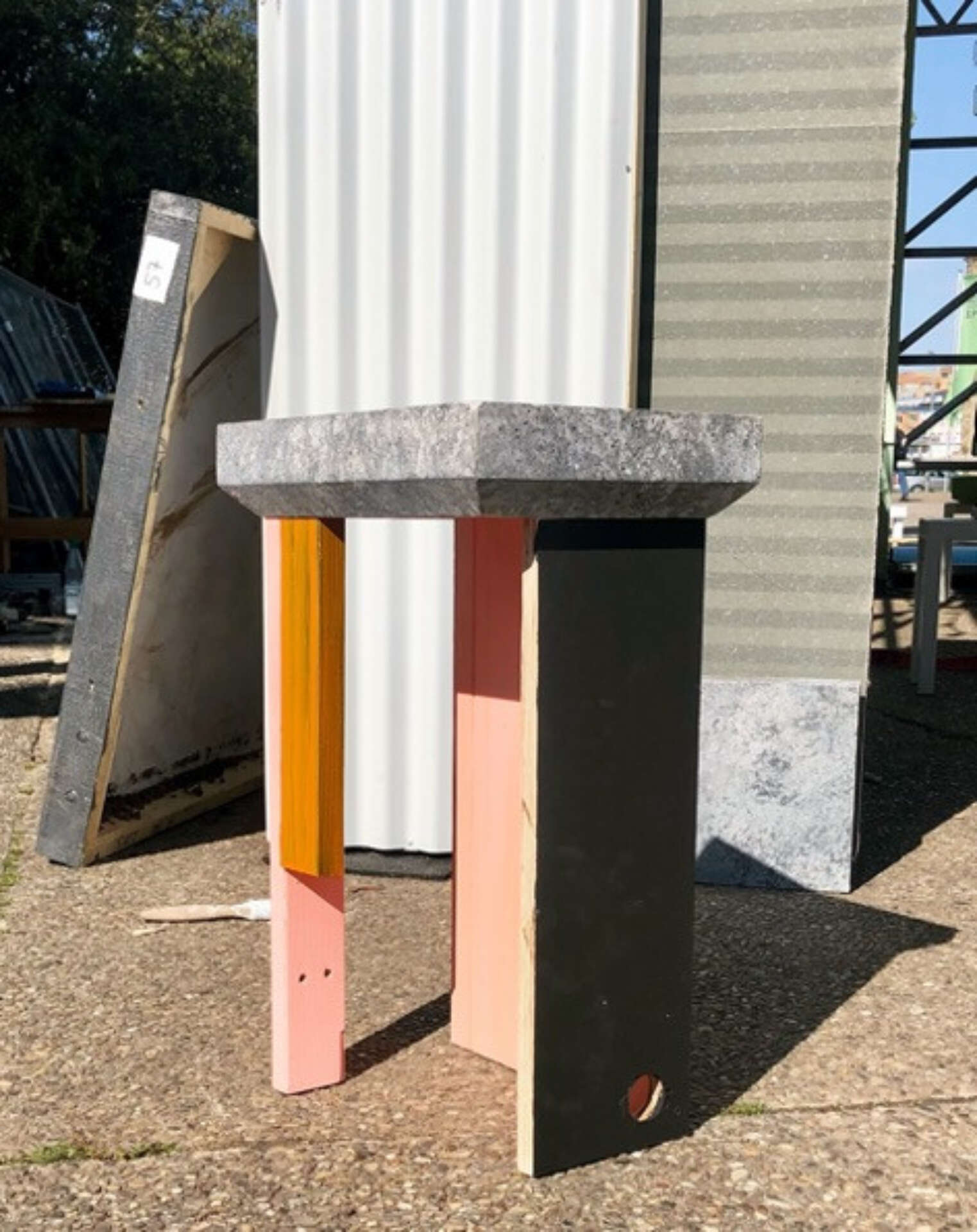
Figure 2: Lustgarten stool: Sculptural stool produced within a participatory and performative construction site with the collective CollColl, using recycled stage set elements from the Staatstheater Stuttgart. An irregular opening in one leg, an asymmetrical leg configuration, and a non-standardized color application emerged through the collective design and assembly process, 2022 ©Luise Leon Elbern
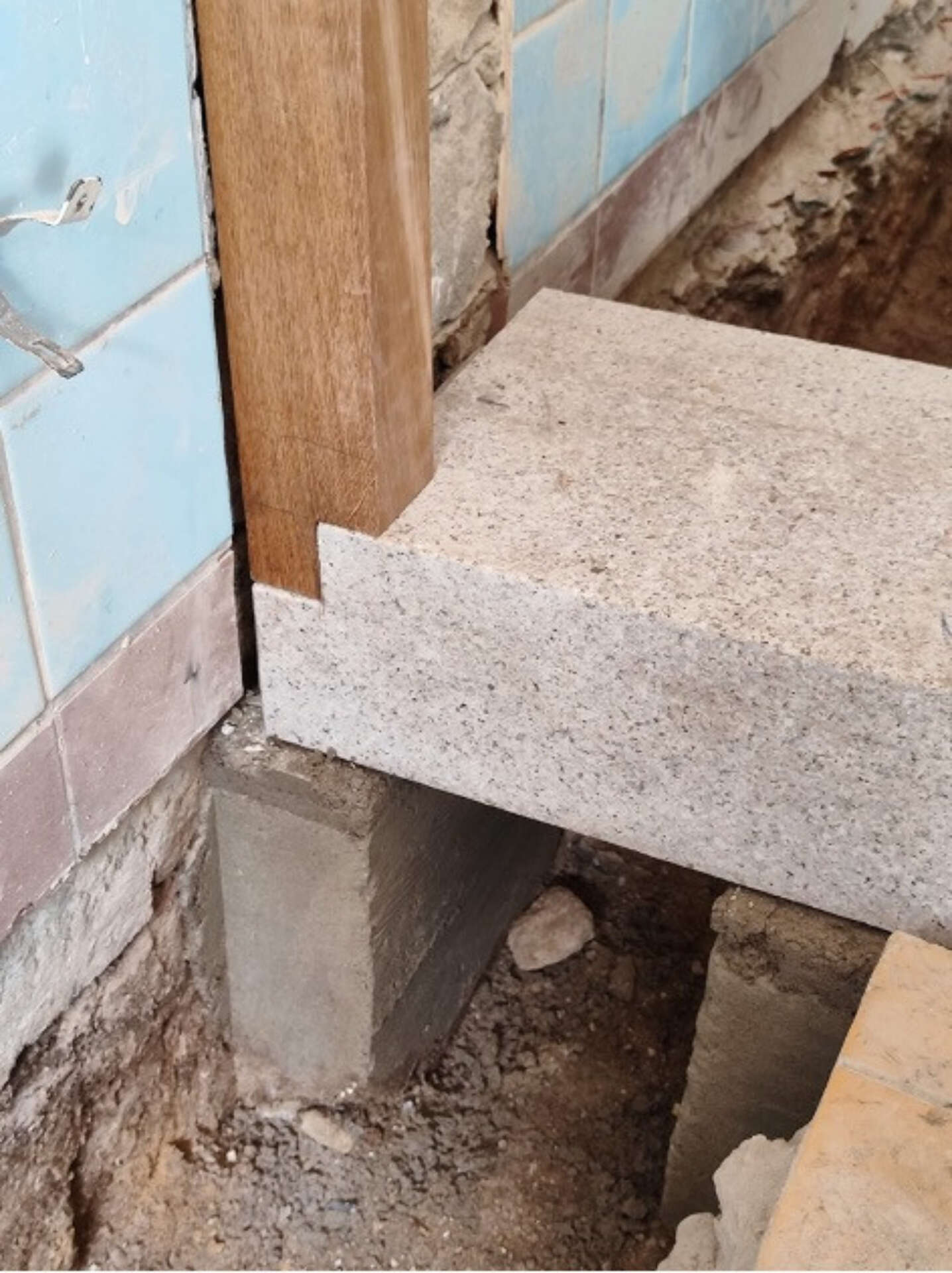
Figure 3: LUnfinished Detail, Versuchsgut Dornburg: Restroom partition wall placed on a granite plinth, selected due to local material availability. Constructed in the RealLab project “Versuchsgut Dornburg” within the design studio at the Chair of Constructive Design and Experimentation (Jun.-Prof. Tim Simon-Meyer), Bauhaus-Universität Weimar. The detail demonstrates how situational decisions and material contingencies shape form, structure, and spatial expression, while introducing a subtle displacement: a typically lightweight partition element—usually executed in materials such as gypsum board or laminate panels—is combined with a heavy, monolithic base. This juxtaposition reflects principles of pragmatic, simple construction and generates both functional solutions and unexpected aesthetic qualities, 2025 ©Luise Leon Elbern
In this light, dominant paradigms such as standardization, predictability, and singular authorship are critically reconsidered. Architecture is reframed as a situated, relational, and process-based practice. Imperfection and “faulty” processes are understood as preconditions for a more open, attentive, sustainable, inclusive, resilient, and adaptive form of making. As Denise Scott Brown remarked:
“Bravely considering the implications of what you see around you and learning from them. Doing so may make your work look incredibly ugly—even to you. But that is the way aesthetic sensibilities change. New patterns and new societies tend to produce things we find ugly (…). But people grow to love them because they are, in the end, right.”4
Inspired by this thought, “mistakes” and a design-oriented “tolerance for error” can be understood as cultural markers that reveal contemporary social, ecological, and economic realities—a kind of “structure of feeling” of our time. The British cultural theorist Raymond Williams (1921–1988) coined this term to describe a collective, often unconscious mood or sensibility characteristic of a particular historical moment. Unlike ideology or official culture, a structure of feeling is implicit and manifests in everyday practices, art, and language before it is formally articulated or politically systematized. It conveys how people experience and feel the world—and often signals emerging social transformations. Artistic expressions are particularly significant in this regard, as they reveal such inarticulate sensibilities before they find conceptual form.
Against the backdrop of contemporary socio-ecological crises, these modes of spatial production acquire renewed urgency. Rethinking architectural practice requires not only technical innovation or regulatory reform but also a profound cultural transformation. It calls for greater generosity and an expanded sensibility capable of articulating new aesthetic and ethical paradigms—ones that embrace unplanned trajectories and cultivate conscious responsiveness to situational conditions.
In this light, mistakes and a cultivated tolerance for error can be understood as cultural indicators that record present socio-ecological realities—a contemporary structure of feeling. When approached with care, attention, and openness, mistakes become tools of possibility. They articulate a flawed yet deliberate aesth-ethical position: an architectural practice that finds relevance not in perfection, but in its capacity to recalibrate direction while moving off course.
- https://www.tate.org.uk/art/art-terms/f/found-object (09.02.2026)
- Alison and Peter Smithson, 'The "As Found" and the "Found"', 1990.
- Vermeulen, Timotheus, and van den Akker, Robin. „Notes on Metamodernism“. Journal of Aesthetics & Culture, 2, no. 1 (2010): 5677. https://doi.org/10.3402/jac.v2i0.5677
- Marta Nowak, “Architecture, Signs, and Social Values: In Conversation with Denise Scott Brown,” 2013