
Reconnecting Waste Exploring Digital Fabrication Technologies for Circular Reuse of Demolition Waste Bricks
Introduction
Construction and demolition waste (CDW) is a major challenge for sustainable urban development. In Germany, nearly 200 million tonnes of CDW are generated annually, with high recovery rates masking a predominance of downcycling processes (Bayram and Greiff, 2023; BMUV, 2023). As a result, significant portions of material lose their structural and cultural value.
Bricks, despite their durability, are frequently excluded from reuse due to irregular geometries, mortar residues, and damage, reflecting broader limitations in current construction and recycling practices (Fořt and Černý, 2020; European Commission. Joint Research Centre., 2023). These conditions reveal a contradiction between conventional standardised construction systems and heterogeneous material realities.
This research, conducted at HafenCity University Hamburg within the RTG Urban Future-making, investigates how digital fabrication can mediate between these conditions. Instead of standardising reclaimed bricks, the project explores how their irregularity can be directly integrated into assembly systems. The research develops as an iterative process shaped by material encounters, computational modelling, and testing. It treats variability as a condition that informs how workflows are structured, positioning design as a means of organising interactions between material, digital, and production; rather than resolving irregularity.
Figure 1: Photo of a demolition site on Bahrenfelderstraße in Altona, Hamburg. Project image by the Author, 2026
State of Research
Recent developments in digital fabrication demonstrate an increasing integration of computational design and construction processes, particularly through parametric modelling and additive manufacturing (Heisel, Schlesier and Hebel, 2019; Johns et al., 2024). These approaches enable customised strategies, highlighting a growing capacity to engage with material complexity within design. However, these operate independently of existing material streams, often only prioritising geometric control. At the same time, research on circular construction emphasises reuse and recycling as key strategies for sustainable practices, highlighting benefits of retaining the existing (CIRCuIT Consortium, 2023; Bellini et al., 2024). Such approaches frequently remain focused on material management and logistics rather than their integration into design processes. As a result, reclaimed materials are often downcycled, limiting the potential for direct reuse and diminishing material specificity (Fořt and Černý, 2020).
Emerging studies begin to address this disconnection by exploring how digital tools can respond to irregular material conditions. Zboinska and Göbel (2025) demonstrate how digital workflows can adapt to the variability of salvaged materials, while Ragazou et al. (2024) and Heisel, Schlesier and Hebel (2019) highlight the role of prototyping and system-based approaches in enabling reuse-oriented strategies. All indicating a shift towards incorporating material variability as an active parameter. However, the connection between material availability, digital workflows, and construction practices continues to be constrained by fragmented supply chains, institutional barriers, and the limited adoption of digital technologies within circular systems (Çetin, De Wolf and Bocken, 2021; Thirumal et al., 2024). In addition, policy frameworks increasingly emphasise the need for approaches that engage directly with material flows, rather than treating reuse as a downstream process (European Commission. Joint Research Centre., 2023). This research is positioned within this gap by focusing on the design of workflows that integrate reclaimed materials into digital fabrication processes.
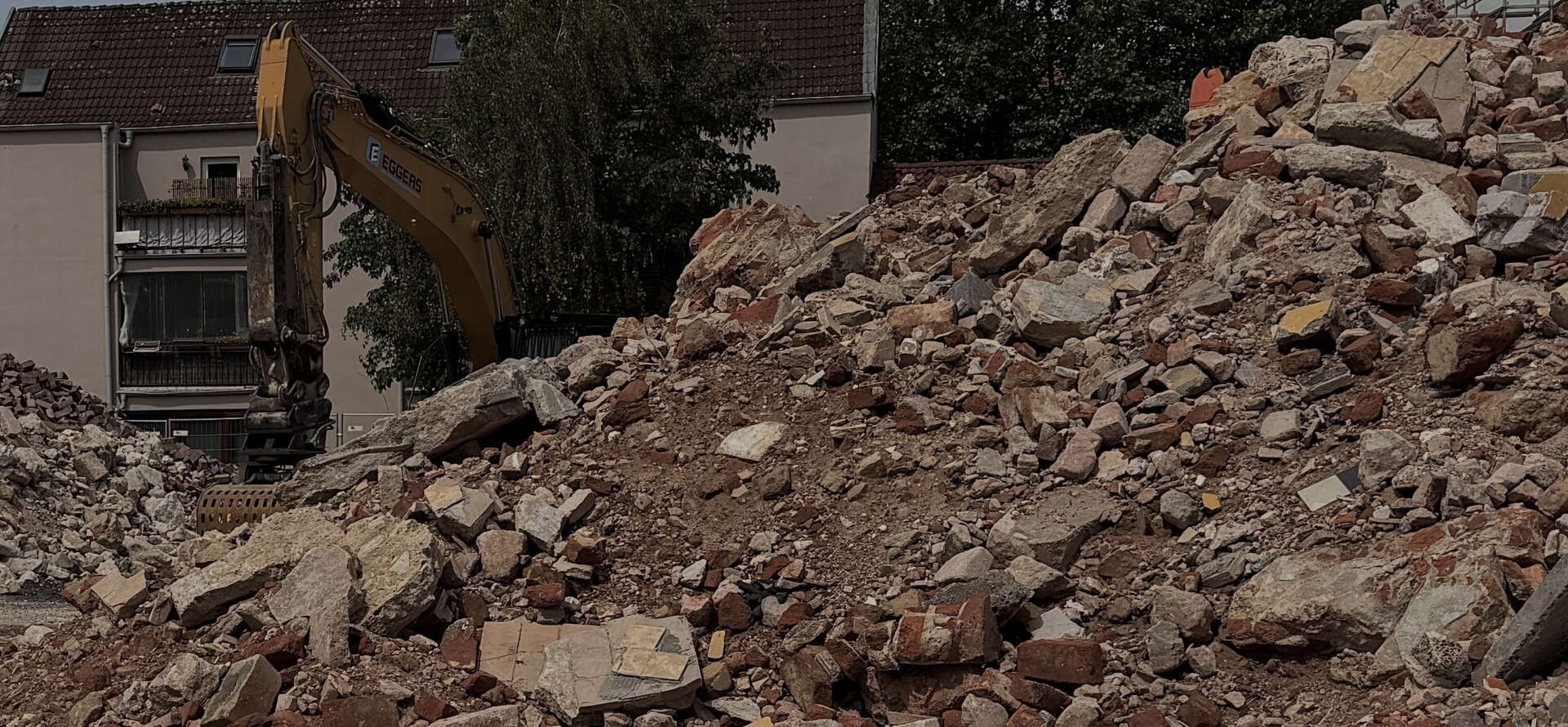
Figure 2: Photo from a demolition site in Hamburg. Everyday dissolution of brick architectures into undifferentiated rubble. Photo by Author, 2026.
Research Focus
This research investigates how workflows for integrating irregular reclaimed bricks into architectural production can be designed through iterative, design-led processes. Rather than a single technical solution, the project examines how sequences of actions—spanning material sourcing, digital modelling, and fabrication—can be structured to accommodate variability in reclaimed materials.
Digital fabrication is both a production tool, and a mediator within this workflow, enabling negotiation between material conditions and design decisions. In this context, the recomposition of discarded bricks into spatial assemblies emerges as a result of the process.
The main research question for this inquiry is as follows:
- How can digitally fabricated connector systems integrate irregular reclaimed bricks into construction workflows while supporting circular reuse practices?
This question is explored through the following sub-questions:
- How can material irregularities of reclaimed bricks be translated into design parameters and spatial configurations?
- How can assembly strategies accommodate variability while enabling reuse?
- What constraints and tolerances emerge when applying digital fabrication to heterogeneous reclaimed materials?
- How do local material flows and stakeholders influence the realisation of such assemblies?
These questions structure the research around a central design problem, linking material behaviour, digital workflows, and construction practices. The project approaches reuse as an integrated process in which technical, material, and contextual factors are addressed through iterative design experimentation.
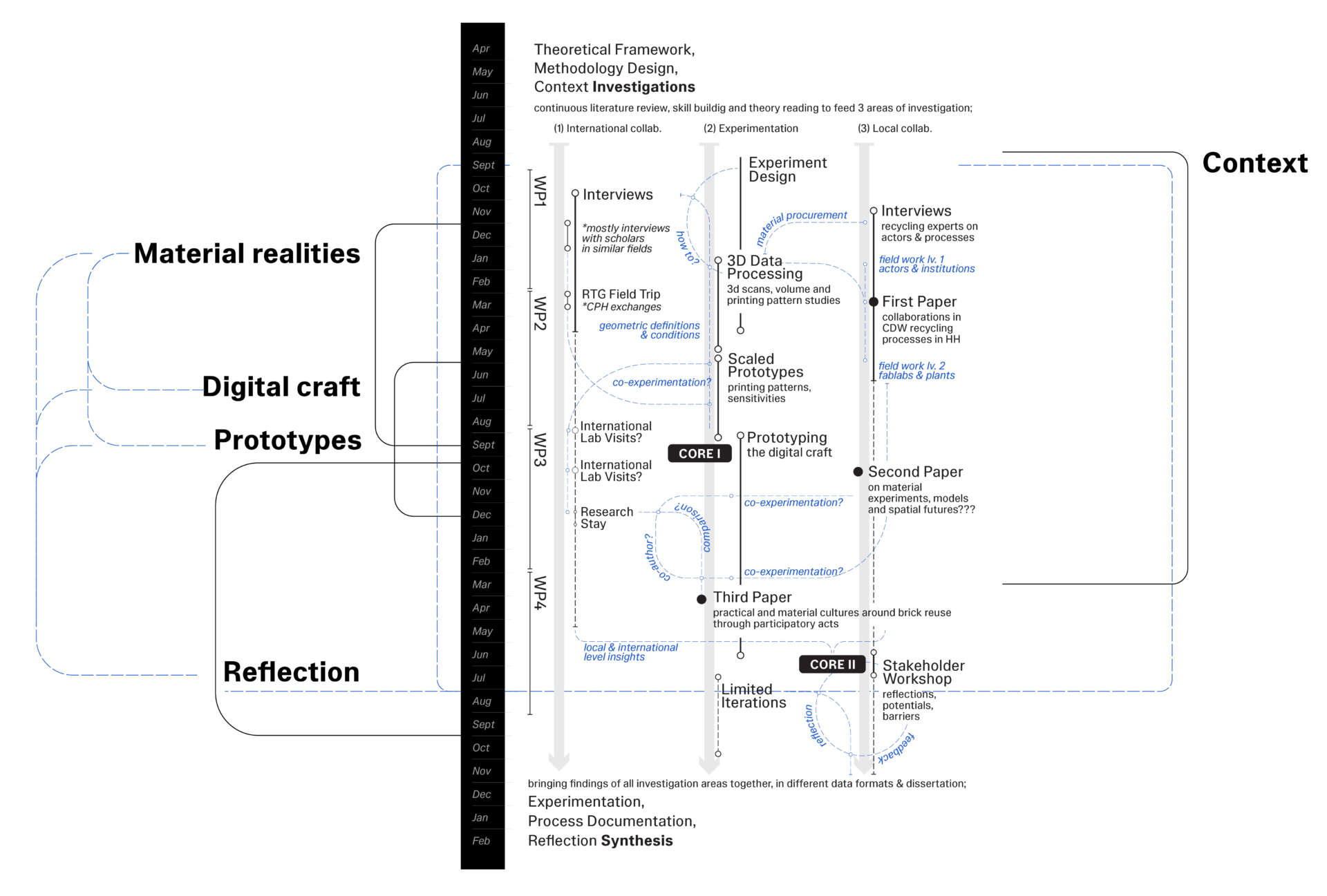
Figure 3: Time plan, work packages, and theories feeding the different processes of the research. Visualization, Graphics: Author, 2026.
Methodological Approach
The project follows a design-led, iterative methodology combining material investigation, computational modelling, and prototyping; developed through successive cycles in which each phase informs the next. Approaching Hamburg as a situated case, where existing demolition practices, material flows, and institutional frameworks provide the conditions for testing and developing workflows, the research is organised into interconnected work packages:
- WP01 – Mapping CDW flows and actors
- WP02 – Digital capture and modelling
- WP03 – Prototyping
- WP04 – Collaborative reflection
- WP05 – Synthesis
Within this framework, prototypes function as test situations where material behaviour, design assumptions, and stakeholder perspectives intersect (Marres and Stark, 2020). In this sense, they operate as sites where technical feasibility and evaluative criteria are negotiated (Stark et al., 2009), revealing constraints, exposing mismatches, and guiding the ongoing development.
Research Trajectory
The research develops through contextual analysis and material experimentation, rather than following a linear progression from problem to solution. This approach aligns with practice-based research frameworks where knowledge emerges through iterative engagement and making (Jacobs and Merriman, 2011; Farías and Criado, 2018).
Initial phases focus on understanding how CDW is defined, classified, and processed, establishing the conditions under which reuse is considered possible. As the research progresses, reclaimed bricks are treated as active inputs within the workflow. Digital modelling translates material irregularities into parameters that inform fabrication and assembly.
Through prototyping, mismatches between material behaviour and computational assumptions become visible. These moments expose differences between expected and actual performance, leading to adjustments in both design strategies and the organisation of the workflow.
Collaboration also plays a central role in this process. Prototypes act as shared reference points and can be understood as ‘boundary objects’ facilitating exchange between different actors (Star, 2010), enabling the integration of multiple perspectives.
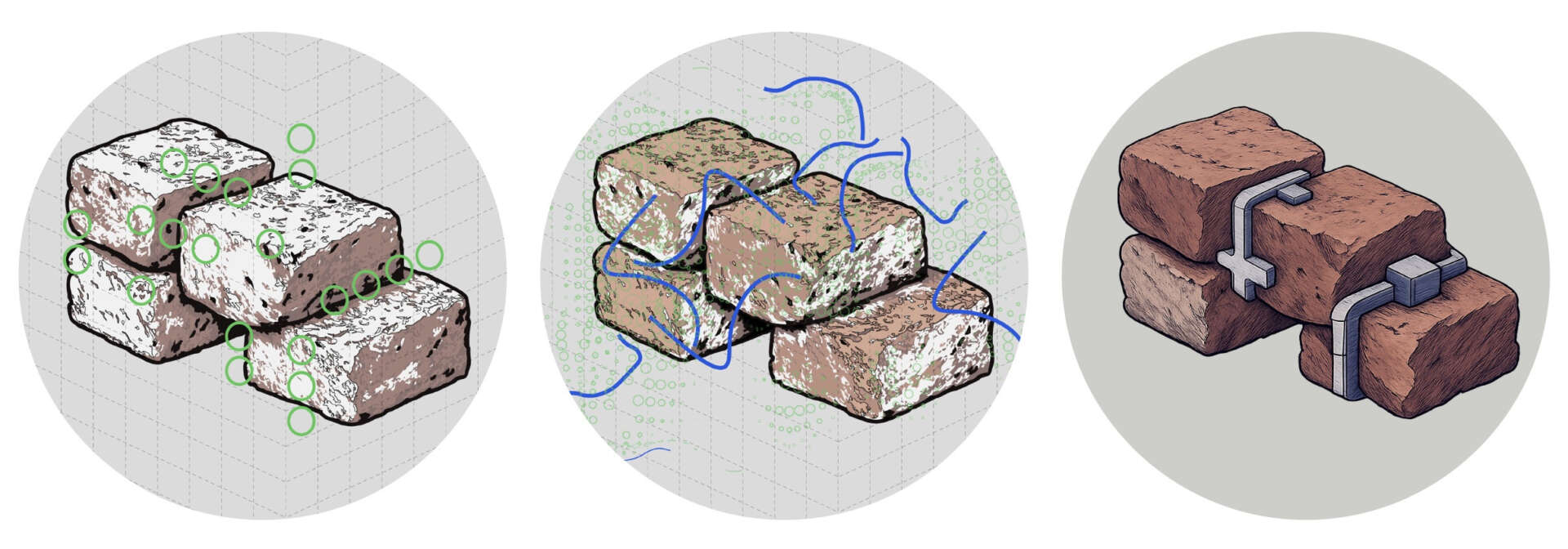
Figure 4: Diagram illustrating process, (1) documentation of reclaimed bricks through digital capture and parametric modeling, (2) exploratory assembly possibilities, and (3) one final stage prototype. . Photo by Author, 2026.
Material and Process
Field observations at demolition sites in Hamburg show how brick structures are dismantled and transformed into mixed rubble, reflecting current local practices of material handling and downcycling. This condition defines the starting point of the research.The project investigates how this material can be reintroduced into construction without imposing uniformity. Irregularity is treated as a defining characteristic rather than a defect.
Digital fabrication mediates between variability and assembly requirements. Parametric modelling incorporates material differences into the workflow, while additive manufacturing enables customised responses to specific material conditions. This interaction between material and digital processes shapes the resulting assemblies and the development of the workflow.
Contribution
The research generates empirical insights into tolerance, assembly logic, and reversibility through prototyping, and demonstrates how design processes can be reorganised around irregular conditions. By focusing on the structuring of workflows, the project reframes reuse as a process embedded within architectural production. In this way, reuse shifts from a problem of standardisation to a question of integration, positioning workflow design as a key site of intervention in circular construction practices.
In this respect, the research also contributes conceptually by engaging with perspectives that understand design processes as sites of negotiation between material, social, and technical dimensions (Fratini, Georg and Jørgensen, 2019). While grounded in Hamburg as a case study, the research develops transferable insights into how such workflows may be adapted to other urban contexts.
Conclusion
This research frames reuse as an evolving process shaped by iterative engagement with materials, tools, and actors. By combining contextual analysis with design experimentation, it demonstrates how workflows can support circular construction practices through digital fabrication. The project develops through continuous refinement, where each phase informs the next. Reuse is not treated as a downstream operation, instead positioned as an active condition within the design process, showing how material variability can be integrated into architectural production through carefully structured workflows.In this sense, the research reframes reuse both as a material challenge, and also as a question of how design processes themselves are organised.
Literature
Bayram, B. and Greiff, K. (2023) ‘Life Cycle Assessment on Construction and Demolition Waste Recycling: a systematic Review Analyzing three Important Quality Aspects’, The International Journal of Life Cycle Assessment, 28(8), pp. 967–989. Available at: https://doi.org/10.1007/s11367....
Bellini, A. et al. (2024) ‘Achieving a Circular Economy through the Effective Reuse of Construction Products: A Case Study of a Residential Building’, Journal of Cleaner Production, 450, p. 141753. Available at: https://doi.org/10.1016/j.jcle....
BMUV (2023) Waste Management in Germany 2023: Facts, Data, Graphics. Annual Report. Dessau-Roßlau, Germany, p. 44. Available at: https://www.umweltbundesamt.de....
Çetin, S., De Wolf, C. and Bocken, N. (2021) ‘Circular Digital Built Environment: An Emerging Framework’, Sustainability, 13(11), p. 6348. Available at: https://doi.org/10.3390/su1311....
CIRCuIT Consortium (2023) Circular Construction in Regenerative Cities: Insights from the CIRCuIT Project. Final Report. CIRCuIT Consortium / European Commission, p. 284. Available at: https://report.circuit-project... (Accessed: June 11, 2025).
European Commission. Joint Research Centre (2023) Techno-economic and Environmental Assessment of Construction and Demolition Waste Management in the European Union: Status Quo and Prospective Potential. LU: Publications Office. Available at: https://doi.org/10.2760/721895.
Farías, I. and Criado, T.S. (2018) ‘Co-laborations, Entrapments, Intraventions: Pedagogical Approaches to Technical Democracy in Architectural Design’, Diseña, (12), pp. 228–255. Available at: https://doi.org/10.7764/disena....
Fořt, J. and Černý, R. (2020) ‘Transition to Circular Economy in the Construction Industry: Environmental Aspects of Waste Brick Recycling Scenarios’, Waste Management, 118, pp. 510–520. Available at: https://doi.org/10.1016/j.wasm....
Fratini, C.F., Georg, S. and Jørgensen, M.S. (2019) ‘Exploring Circular Economy Imaginaries in European Cities: A Research Agenda for the Governance of Urban Sustainability Transitions’, Journal of Cleaner Production, 228, pp. 974–989. Available at: https://doi.org/10.1016/j.jcle....
Heisel, F., Schlesier, K. and Hebel, D.E. (2019) ‘Prototypology for a Circular Building Industry: the Potential of Re-used and Re-cycled Building Materials’, IOP Conference Series: Earth and Environmental Science, 323(1), p. 012023. Available at: https://doi.org/10.1088/1755-1....
Jacobs, J.M. and Merriman, P. (2011) ‘Practising Architectures’, Social & Cultural Geography, 12(3), pp. 211–222. Available at: https://doi.org/10.1080/146493....
Johns, J. et al. (2024) ‘Additive Manufacturing and Circular Economies’, in R. Charef, Circular Economy for the Built Environment. 1st ed. London: Routledge, pp. 250–267. Available at: https://doi.org/10.1201/978100....
Marres, N. and Stark, D. (2020) ‘Put to the Test: For a new sociology of testing’, The British Journal of Sociology, 71(3), pp. 423–443. Available at: https://doi.org/10.1111/1468-4....
Ragazou, K. et al. (2024) ‘Integration of Circular Economy and Urban Metabolism for a Resilient Waste-Based Sustainable Urban Environment’, Urban Science, 8(4), p. 175. Available at: https://doi.org/10.3390/urbans....
Star, S.L. (2010) ‘This is Not a Boundary Object: Reflections on the Origin of a Concept’, Science, Technology, & Human Values, 35(5), pp. 601–617. Available at: https://doi.org/10.1177/016224....
Stark, D. et al. (2009) The Sense of Dissonance: Accounts of Worth in Economic Life. Princeton University Press.
Thirumal, S. et al. (2024) ‘Barriers to Adopting Digital Technologies to Implement Circular Economy Practices in the Construction Industry: A Systematic Literature Review’, Sustainability, 16(8), p. 3185. Available at: https://doi.org/10.3390/su1608...
Zboinska, M.A. and Göbel, F. (2025) ‘Digital tool Integrations for Architectural Reuse of Salvaged Building Materials’, Automation in Construction, 170, p. 105947. Available at: https://doi.org/10.1016/j.autc...T