
Stereoscopic Drawing Experiments
Introduction
As this research project aims to explore “Baroque spatiality,” a brief introduction to the concept is necessary before discussing the role of the stereoscope in spatial perception and drawing as a research practice.
In descriptions of Baroque architecture notions of movement, indeterminacy, infinity or liveliness appear repeatedly. The writer and semiotician Umberto Eco names its “dynamic” quality that “tends to an indeterminacy of effect (…); it conveys the idea of space being progressively dilated.” (Eco, 1989, p. 7), while the art historian Heinrich Wölfflin remarks how “in the face of this intangibility the eye remains perpetually in a state of unrest” (Wölfflin, 1992, p. 72) making the Baroque an example of “a completely new conception of space directed towards infinity” (Wölfflin, 1992, p. 64). The responsibility for this spatial experience sits within the notion of the “painterly”, which puts the effects of light first, but also includes “dark depth” and layered “masses of interpenetrating and overlapping forms” as well as an avoidance of “a clear contour” (Wölfflin, 1992, p. 64). There is a sense of depth in these spaces, a specific spatiality that brakes open into the indefinite “the orthogonal and closed tectonic space” (Damisch, 2002, p.4), that does not restrict itself to the Baroque, but resides in these descriptions and summarizes under the notion “Baroque spatiality”.
This sort of spatiality may not be entirely grasped within the sets of tools, that the projection drawings offer to architects, therefore this project looks toward linkages between the experienced space and the space of the drawing. The stereoscopic gaze in the early devices of photogrammetric surveying (Deville,1902) provides such an entryway by superimposing the drawing space with the spatial image where its depth can be measured, mapped and drawn. However, as will be further developed throughout this paper, the relationship between these spaces is far from straightforward.”
Stereoscope for Spatial Perception
As the art critic Jonathan Crary states in “Techniques of the Observer”, during the 19th century, the understanding of the relationship between the senses changed along with visual culture (Crary, 1990, p.19)—with the research on stereopsis as well as the popular reception of the stereoscope playing its part in it. Looking towards developments in the history of surveying, instances of the presence of the embodied observer appear in the processes and drawn constructs at closer look, but according to Crary, our relationship with vision is now biased by a scientific understanding as a consequence of modernity. On the one hand there is an understanding that visual perception is “a continuous process, a flux of temporally dispersed contents” (Crary, 1990, p.100) and on the other we see a “denial of the body (…) as the ground of vision.” (Crary, 1990, p.138) This points to a dialectical situation in the understanding of the notion of depth either as measured or as experienced (imagined) and the entanglement of the projective drawing within this.
The notion of depth goes beyond measured distance. Instead, it resides within spatial imagination. The philosopher Maurice Merleau-Ponty critiques the idea of “depth as an objective, stable geometric entity.” (Pérez-Gómez and Pelletier, 2000, p.337) As a consequence, depth must always be sought anew through experience. (Pérez-Gómez and Pelletier, 2000, p.338) The architectural historians and theorists Alberto Pérez-Gómez and Louise Pelletier state “Depth is neither the prosaic interval between nearby and distant objects that one observes from above, nor the concealment of layered things that a perspectival drawing represents.” (Pérez-Gómez and Pelletier, 2000, p.334) Spatial perception thus must be seen as a much more malleable concept, that resides in a subject’s imagination. With that in mind, we can find potential in involving the participant in a spatial experience within which to embrace uncertainty and delay in spatial perception.
The philosopher George Berkeley promotes in his “An essay towards a new theory of vision.” (Berkeley, 1709) the idea that vision and depth are separated entities, claiming that depth comes to mind as an idea, a knowledge built on previous tactile experiences, which situates depth in the realm of touch rather than vision. This understanding was challenged with the invention of the stereoscope. In 1838 the physicist and inventor Charles Wheatstone demonstrated the effects of binocular vision for the experience of depth and with that located space perception in the sense of vision rather than touch. He applied “the systematic experimental procedures of physics to the phenomena of depth perception” (Wade and Ono, 1985) and proved that spatial depth occurred as a cognitive process resulting from the different angles under which the eyes perceived, rather than as a perceptive process within the retina. He realizes that “the mind perceives an object of three dimensions by means of the two dissimilar pictures projected by it on the two retinae” (Wheatstone, 1838, p.373), a phenomenon later termed “binocular disparity”.
In his samples he uses “pairs of outline figures, calculated to give rise to the perception of objects of three dimensions when placed in the stereoscope” (Wheatstone, 1838, p.376). To facilitate the view of these probes, he designed the mirror stereoscope, that diverted the visual path in such a way, that each eye would be presented an image as if in the proper direction of sight. With these samples he shows how just the dissimilarity between the images in each eye causes the mind to form a relief of an object from the images. “By leaving them [shading or coloring] out of consideration no room is left to doubt that the entire effect of relief is owing to the simultaneous perception of the two monocular projections, one on each retina” (Wheatstone, 1838, p.376), (Fig 1.).
Figure 1: Stereoscopic image pairs from Wheatstones’ seminal paper on binocular vision (1838) © Public domain.
His experiments with wireframe figures described as “outline figures of three dimensions” (Wheatstone, 1838, p.378) reveal that the 3-dimensional form of these objects can be recognized without ambiguity. The vividness of such a relief diminishes with the distance of the object before the eyes and “becomes less and less as the object is seen at a greater distance before the eyes, and entirely ceases when it is so distant that the optic axes are parallel while regarding it.” (Wheatstone, 1838, p.380)
Expanding on the invention of the stereoscope, Wheatstone developed further experiments that led to his findings how depth experience could be manipulated by altering angle of view and distance to the image pair. He could show how perceived depth appeared true if these parameters aligned with the properties of the image sets, while it could equally be enhanced or diminished when altering distance and angle. An inversion of depth experience occurred when mirroring the image sets (Wheatstone, 1852). These explorations opened a pathway to Helmholtz’ Tele-stereoscope, a viewing apparatus that diverted the sightline to perceive an actual view rather than a set of images, through an enhanced eye distance resulting in altered size and distance perception, while at the same time making depth appear respectively deeper or shallower (Helmholtz, 1857).
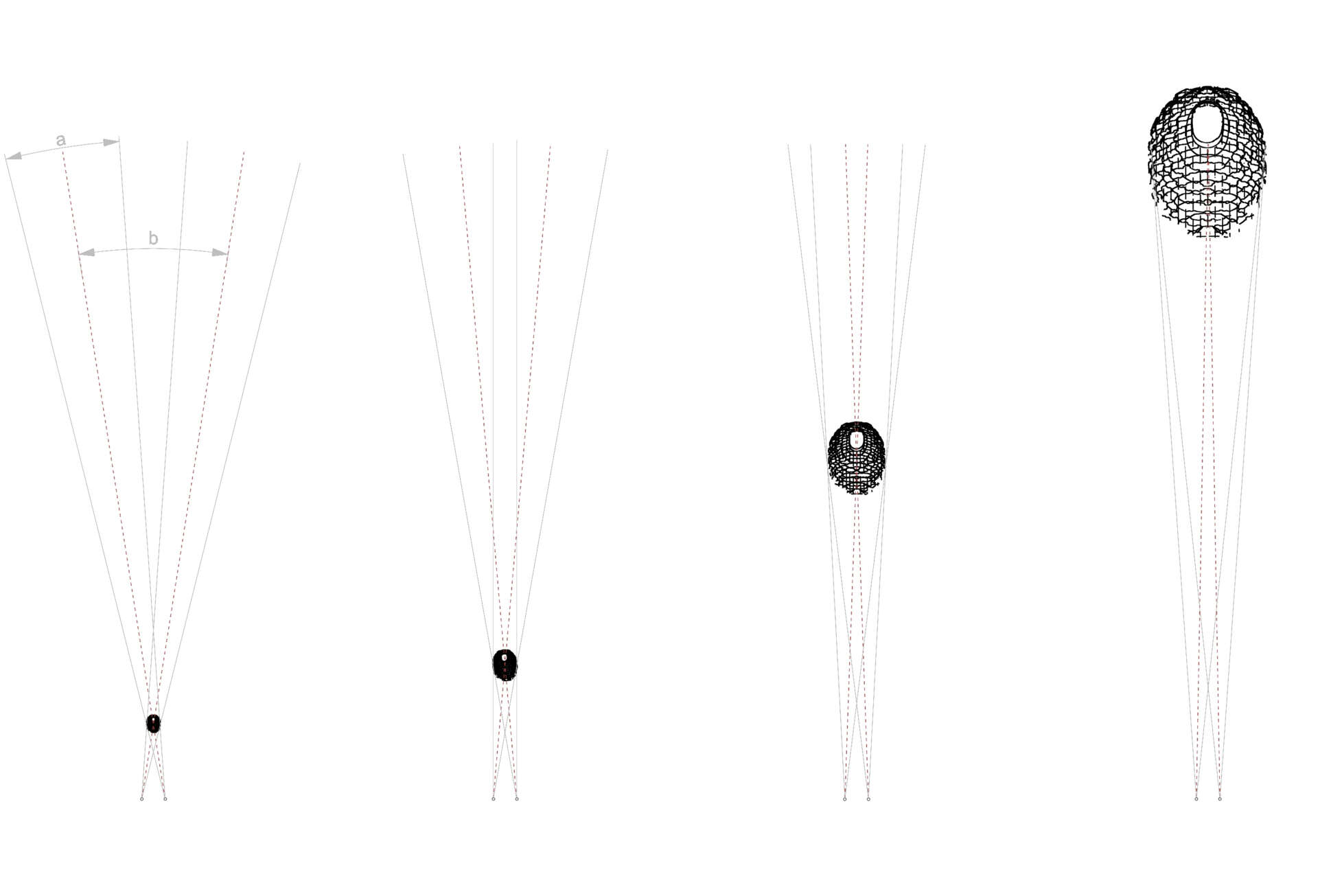
Figure 2: The sequence of diagrams speculates on the stereoscopic depth perception of an observed object following a reasoning on scale, size and distance. The visual cone of each eye is displayed, observing an object at different distances from the eye. The constant here is that the angle (a) that the object occupies within the field of vision does not change, while the size and distance of the object increases. With a constant angle occupied in the visual field, the object does not take different amount of space on the retina, its size on the retina remains the same. What does change, is the angle (b), under which the item is seen and as such the vividness of depth perception. While the angle decreases, the images on the retina resemble more and consequently the depth of the object flattens. Drawing by the author.
With the invention of the Daguerreotype and Talbotype, another version of the stereoscope became popular, known as the lenticular stereoscope and invented by the physicist Sir David Brewster. It has the advantage of a small size and is particularly suitable to view small images (Wade, 2025, p.4). This stereoscope became widely known through its popularity to view scenic sites, rarities and intimate scenes. A view could now be experienced separated from its physical substance. Still, seeing through a stereoscope has specific qualities that distinguishes it from an actual perception. As we are viewing two images with a slightly different viewpoint our vision composes a spatial scene. The contradiction between the depth experience and the flat space of the image becomes most pointedly exemplified in Jonathan Crary’s description. He observes that the elements at different depths appear “planar” floating with an undefinable empty space between them (Crary, 1990, p.125). An effect named binocular occlusion causes this phenomenon. It has been described previously by Leonardo da Vinci. It is therefore also known as “da Vinci stereopsis”. “The presence of an object in the foreground creates regions of the background that can be seen by one eye only. These unpaired image points provide potent cues for depth and occlusion.” (Ponce and Born, 2008, p.846)
The stereoscope emerges as a pivotal device in changing understandings of visuality and binocular spatial perception. “The subsequent dissociation of touch from sight occurs within a pervasive ´separation of the senses´ and industrial remapping of the body in the nineteenth century. The loss of touch as a conceptual component of vision meant the unloosening of the eye from the network of referentiality incarnated in tactility and its subjective relation to perceived space.” (Crary, 1990, p.19). For this project, it raises the questions, whether such devices might also offer potential for a reconciliation of embodied space, its tacit and visual dimensions, in relation to the projection drawing and the notion of spatial imagination. The view through the stereoscope offers a particularly haptic spatial experience (Plunkett, 2013, p.396). This was applied in the field of surveying in 1902 by Edouard Deville who made use of the tangible quality of the stereoscopic image and establishes the link to descriptive geometry by drawing horizontal sections within a stereoscopic image to obtain topographical maps (Deville, 1902).
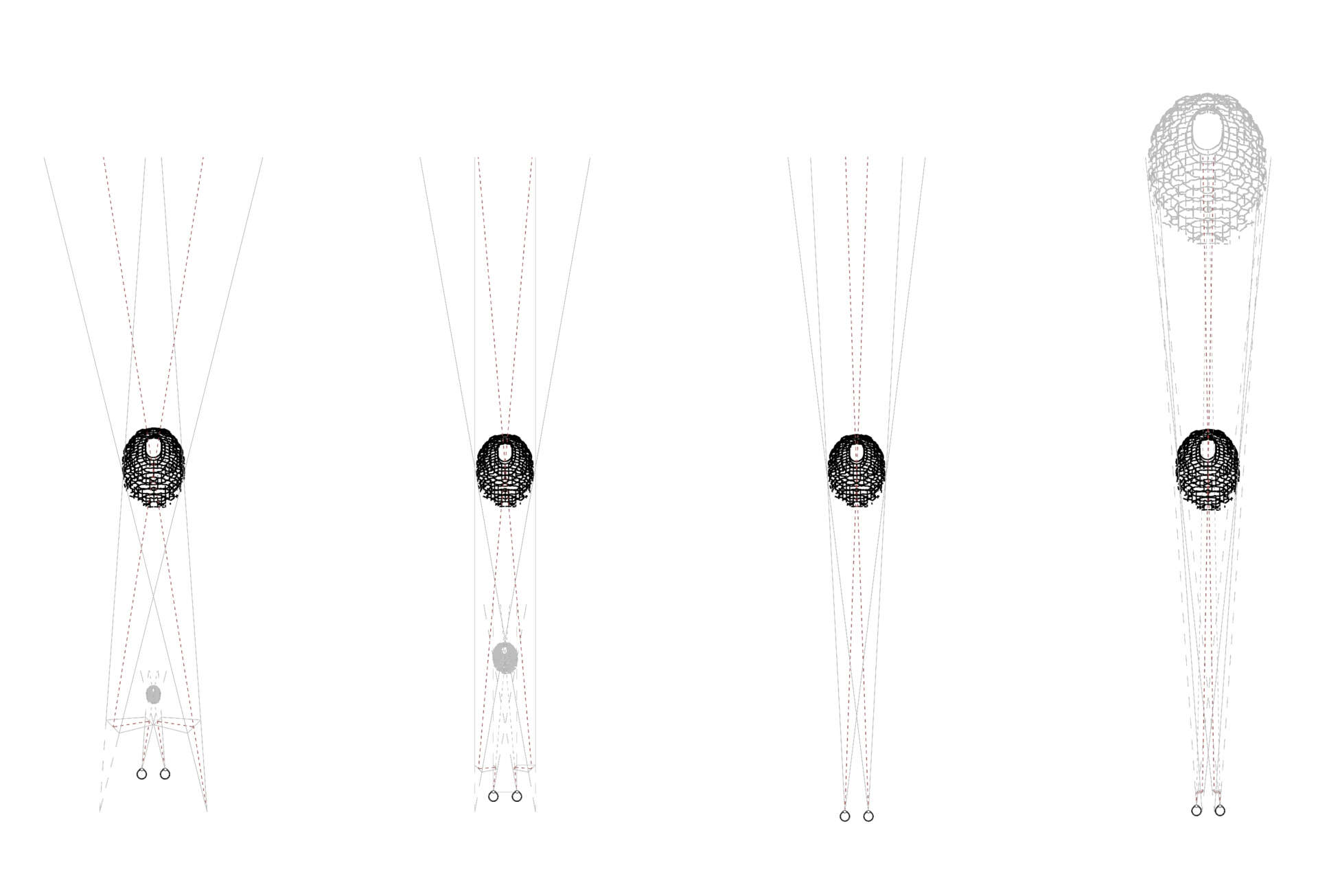
Figure 3: By diverting the visual path using mirrors in the fashion of the tele-stereoscope, the angle under which an item is seen, can be adjusted. As a consequence, the perceived distance and size of the object is altered. A larger angle will show the item smaller and closer, while a smaller angle will make the item appear larger and further away. Drawing by the author.
Stereoscopic drawing experiments
In this research project the stereoscopic experiments and applications provide pathways for developing a drawing device, that reconnects to the concerns around vision and depth perception, while exploring from an embodied standpoint its relations to the Cartesian space, to answer to the question of exploring the notion of “Baroque spatiality”. The proposed device is not a stereoscope per se as it views out towards an object rather than an image set, the spatiality of the image is therefore not a process of resolving a stereoscopic image pair into a spatial image. ‘Binocular’ might be a more suitable term. Instead, it combines properties of the camera lucida, which superimposes the drawing space and the image space, with the integration of a binocular view (Fig. 4).
There are different aspects to the project, that need to be taken into account further: the optical development of the device, the references that are observed with the device and the experience and consequence for the drawing process, which are in different ways entangled with each other. Further tests with the drawing device will reveal an extended understanding of projective drawing with enhanced possibilities of embodied spatial imagination making use of Deville’s surveying method. Wheatstone’s extended stereoscopic experiments with mirror angle and distance adjustments, as well as Helmholtz’ extension of the eye distance, point towards possibilities to use the device in context of different model sizes and scales as well as making adjustments to the perception of the scale. This might resolve a persistent concern, that depth perception is distance dependent, while the device operates at a model scale. While scale is a concern, the size of the drawing device is relevant to the experience of the drawing process. Brewster’s lenticular device offers here an example for the value a spatially more efficient optic provides for usability. At this stage the drawing device has to prove its usability in exploring samples that are representatives for ‘Baroque spatiality’. The evolvement of the drawings in the entangled place between the measured and the perceived will devise trajectories for future adjustments.
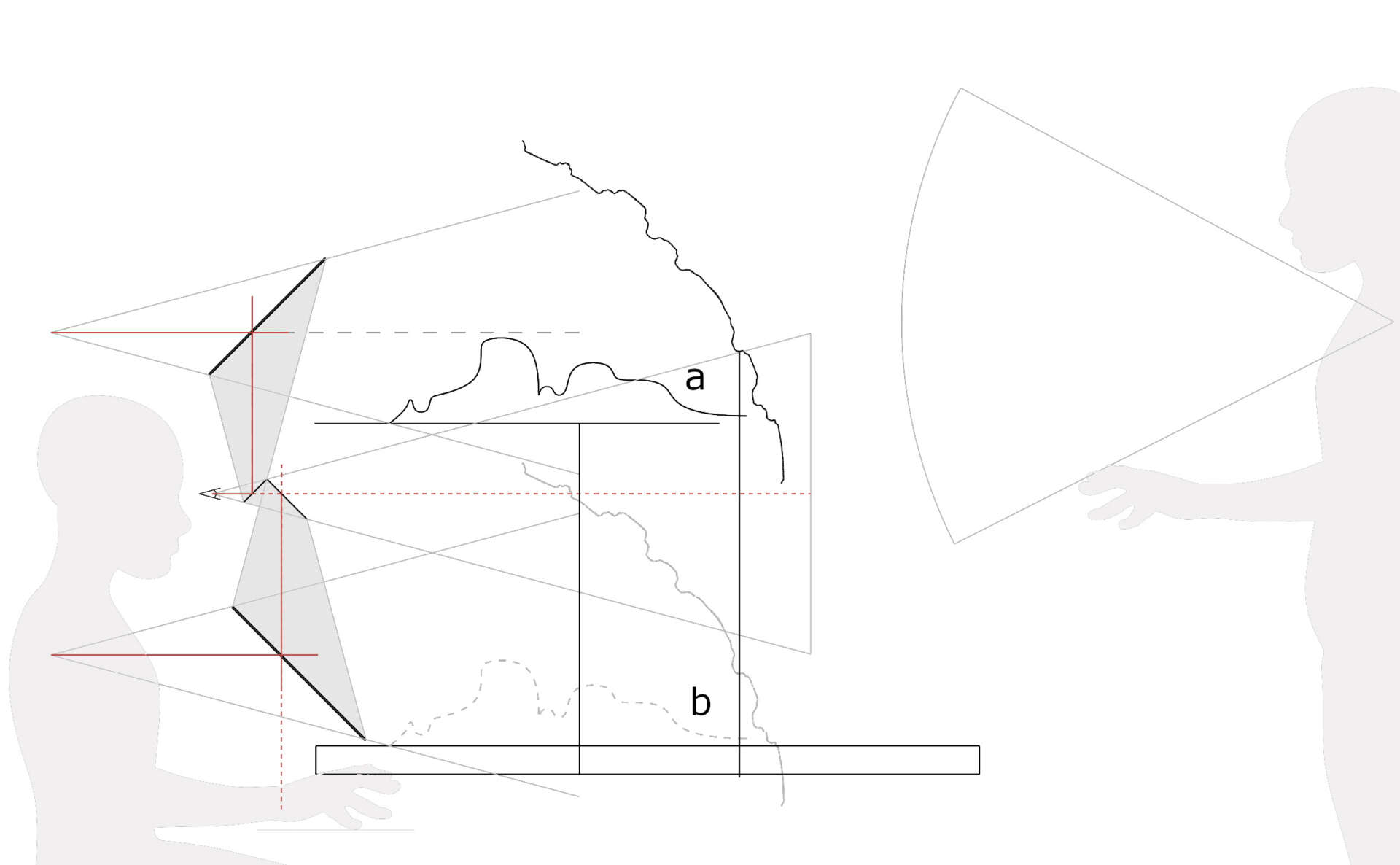
Figure 4: The drawing device LUCIDA V2 proposes to align the superposition of the drawing space and the model space, in such a way, that the reflected object is located below the object, so that the camera can be easily moved along a horizontal plane, without losing consistency between model and drawing. Drawing by the author.
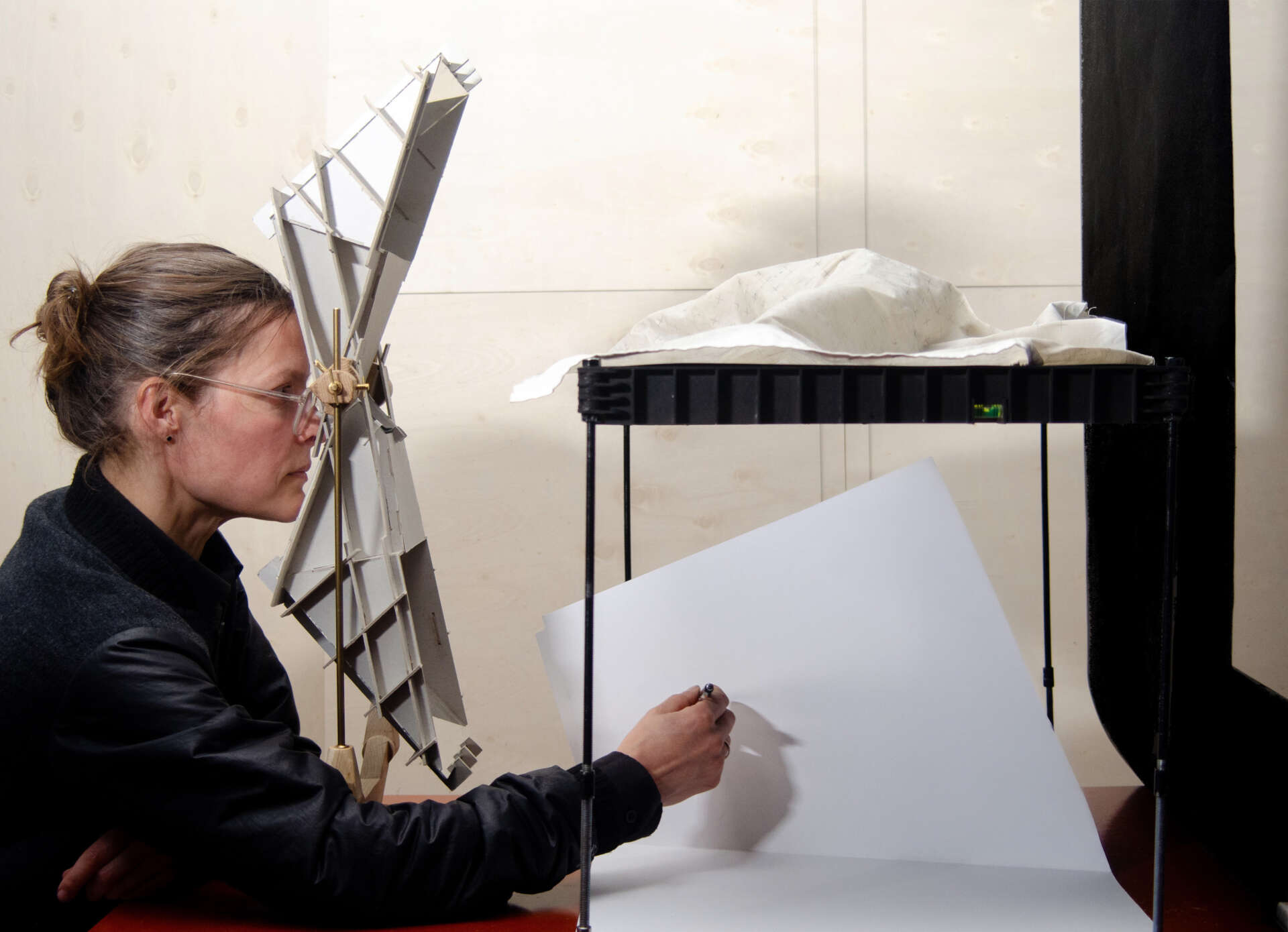
Figure 5: The drawing device in use. Photo by the author.
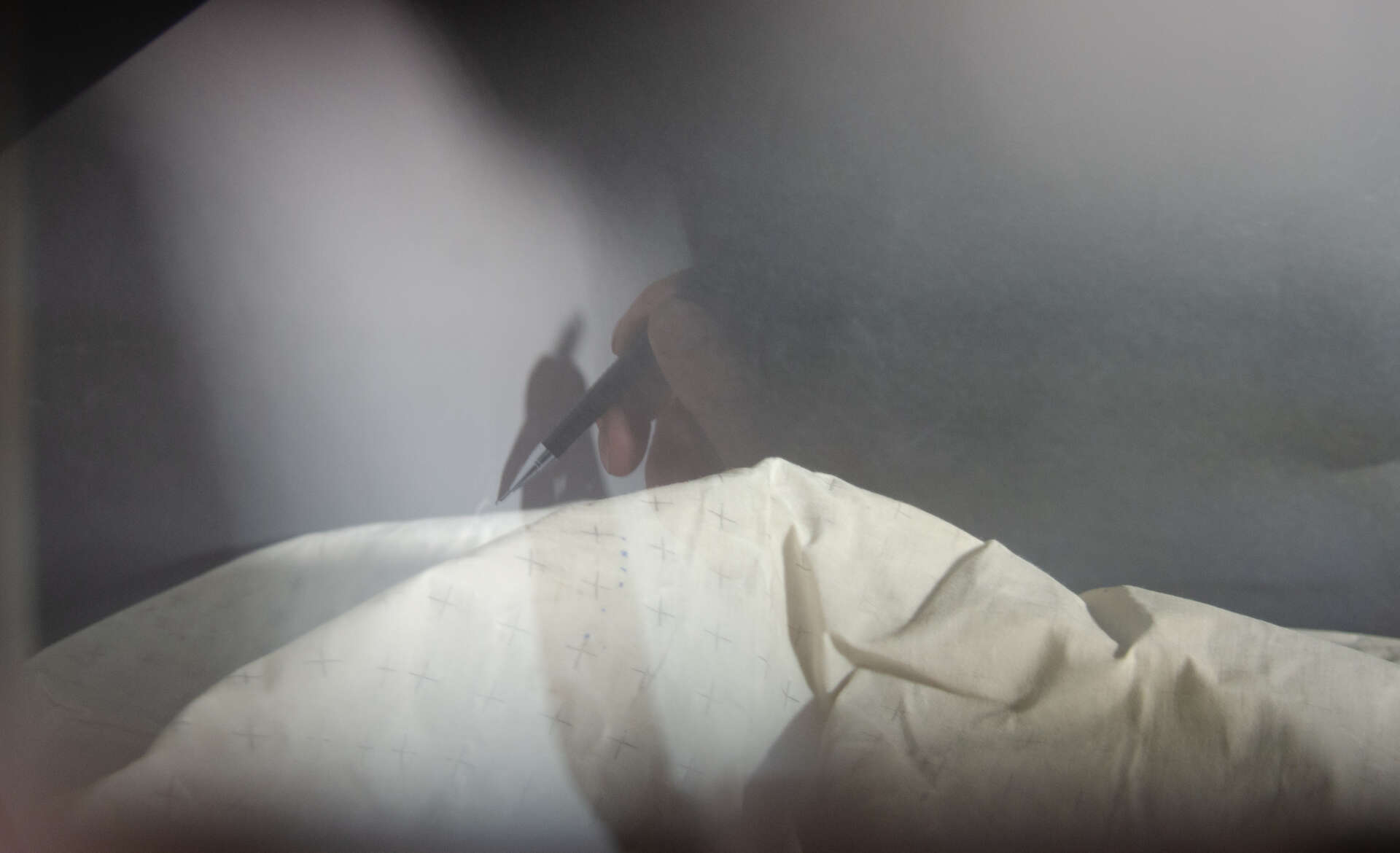
Figure 6: The view through the drawing device shows model space and drawing space superimposed. Photo by the author
Literature
Berkeley, G. (1963). ‘An Essay toward a new Theory of Vision [1709]’, Reprinted in Works on vision. Bobbs-Merrill.
Crary, J. (1990) Techniques of the Observer: on Vision and Modernity in the Nineteenth Century. Cambridge: MIT Press.
Damisch, H. (2002) A Theory of /Cloud/: toward a History of Painting, Cultural Memory in the Present. Stanford: Stanford University Press.
Deville, E.G.D. (1902) On the Use of Wheatstone Stereoscope in Photographic Surveying, in: Proceedings and Transactions of the Royal Society of Canada Second Series.
Eco, U. (1989) The Open Work. London: Hutchinson Radius.
Helmholtz, H. von (1857) .Das Telestereoskop. Annalen der Physik und Chemie 178, pp. 167–175.
Pérez-Gómez, A., Pelletier, L. (2000) Architectural Representation and the Perspective Hinge. Cambridge: MIT Press,
Plunkett, J. (2013) ‘Feeling Seeing’: Touch, Vision and the Stereoscope. History of Photography 37, pp. 389–396.
Ponce, C.R., Born, R.T. (2008) Stereopsis. Current Biology 18, R845–R850.
Wade, N., Ono, H. (1985) The Stereoscopic Views of Wheatstone and Brewster. Psychological Research 47, pp. 125–133.
Wade, N.J., 2025. The Early History of Visual Virtuality with Two Eyes. In: Virtual Worlds 4, p. 41.
Wheatstone, C. (1838) Contributions to the Physiology of Vision. Part the First. On Some Remarkable, and Hitherto Unobserved, Phenomena of Binocular Vision. Philosophical Transactions of the Royal Society of London 128, pp. 371–394.
Wheatstone, C. (1852) The Bakerian Lecture. Contributions to the Physiology of Vision. Part the Second. On some remarkable, and hitherto unobserved, Phenomena of Binocular Vision (continued). Philosophical Transactions of the Royal Society of London 142, pp. 1–17.