Lines of Transition Walking, Drawing and Research Between Architecture and the City
Abstract
This research emerges from an ongoing attempt to understand transition as a spatial condition rather than a fixed boundary. Starting from the façade, the investigation gradually shifted towards questions of movement, sequence and depth between interior and exterior, public and private realms. The research does not follow a linear path; instead, it unfolds through trajectories shaped by walking, observing, drawing and repeatedly questioning where transition begins and where it dissolves.
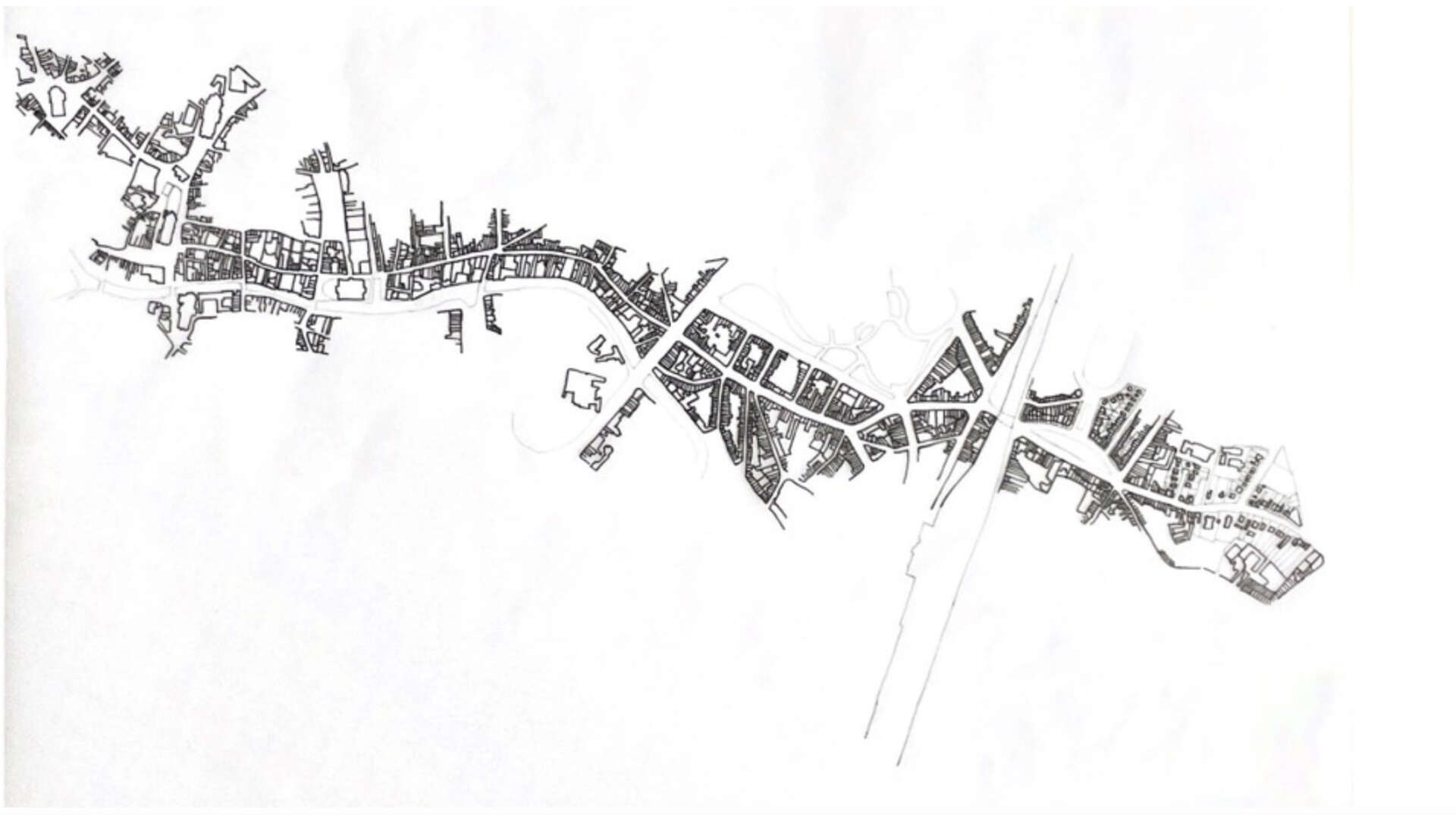
Walking through the city constitutes a central research practice. Streets are approached as trajectories in themselves, where everyday interactions, pauses and informal appropriations reveal how façades operate as mediating spaces. Drawing accompanies these walks as a way of thinking through space. The act of drawing exposes uncertainties and limitations: how to represent layered conditions, how to describe transitions towards upper floors, and how to develop a graphic language capable of capturing spatial depth and movement. These struggles are not obstacles but active drivers of the research process.
The research engages with urban life at the human scale, drawing on approaches to everyday spatial experience (Jan Gehl, 2011). Through selected urban case studies in Ghent (Belgium) and Braga (Portugal), the investigation combines observation, drawing and photography to trace spatial trajectories from the street towards interior spaces and back again.
Rather than aiming at a fixed conclusion, the research unfolds as a situated inquiry into interior– exterior transition, understood as a negotiated and continuously evolving spatial condition. By bringing the trajectory of the research process into alignment with the spatial trajectories it traces, the work positions drawing, walking and uncertainty not as auxiliary methods, but as productive drivers of architectural knowledge within design-driven research. Developed as part of an ongoing doctoral project, the research reflects a PhD process currently at an intermediate stage.