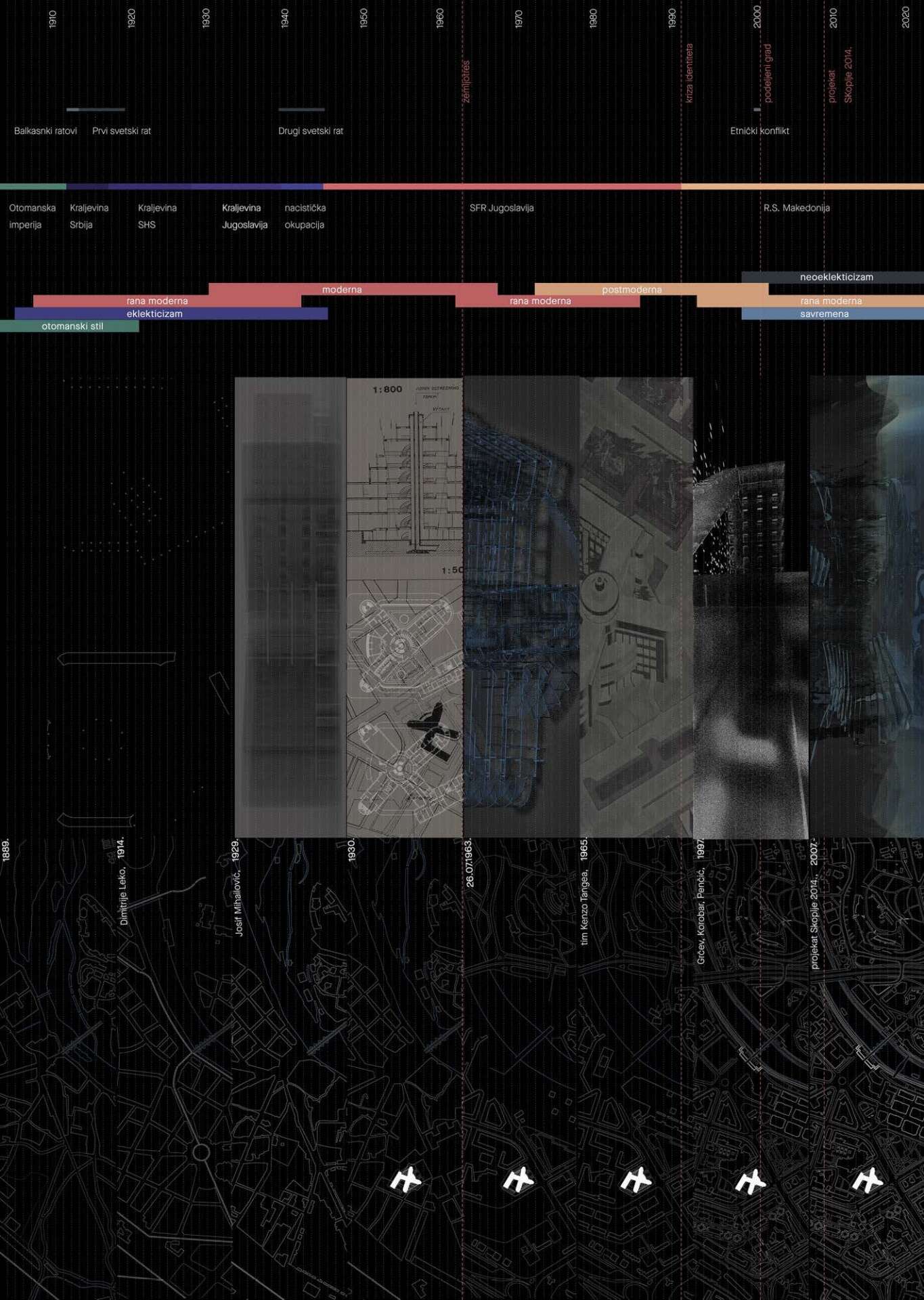
Fragmented Trajectories Visualizing Ideology, Memory and spatial Re-inscription in Skopje
Abstract
Skopje’s urban core reveals successive layers of political transformation, architectural evolution, and the introduction of new symbols, resulting in a fragmented urban narrative. Early modernist initiatives, exemplified by Nikola Dobrović’s unrealised Banovina palace project, established rational frameworks to express statehood and modernity within Yugoslavia. Following the 1963 earthquake, reconstruction efforts led by the United Nations and Kenzo Tange implemented large-scale planning strategies aimed at collective recovery under socialist principles. Subsequent postsocialist developments, particularly the Skopje 2014 initiative, redirected the city’s ideological trajectory. Over time, the accumulation of diverse spatial styles has precluded the formation of a unified identity, positioning architecture as a medium for meaning, memory, and contestation.
This essay investigates these urban transformations through visual design methodologies. Analytical tools such as diachronic maps, layered diagrams, overlays, and sequential drawings are utilised to elucidate the intersections among temporal, ideological, and spatial patterns. Rather than adhering to a linear chronology, Skopje is conceptualised as a palimpsest of ideologies, continuously shaped by processes of addition, removal, and reinterpretation of symbols. Within this framework, architecture both constructs and interrogates collective memory in the post-socialist urban context.